Which Bird Has the Strongest Vision? Discover Nature’s Sharpest Eyes
Birds are known for their extraordinary eyesight, and some species have vision far beyond human capability. Understanding which bird has the strongest vision involves exploring the intricate world of photoreceptor cells, rod cells, and cone cells, which allow birds to see with incredible clarity. Birds rely on their eyes not just for hunting but also for navigation, avoiding predators, and even social interaction. Visual acuity in birds can differ greatly, with raptors eyesight often considered the pinnacle of natural optical precision. For example, an eagle eyesight is so sharp it can spot prey from over two miles away, while smaller birds like hummingbirds use microsaccadic eye movement to track tiny, fast-moving objects with precision.
Birds have evolved unique adaptations such as a fovea, a nictitating membrane, and a visual streak that allow them to process images rapidly and in high detail. Some species even see in ultraviolet light, making birds with UV vision capable of detecting things invisible to humans. From the diurnal hunting of eagles and hawks to the stealthy night hunting of owls, understanding best bird vision is a journey into the remarkable world of avian biology. This guide explores the birds with the strongest eyesight, highlighting birds of prey, small birds with unique visual capabilities, and comparing their vision with human sight.
What Makes Bird Vision So Powerful?
The power of birds with strongest eyesight comes from a combination of structural and functional adaptations. Unlike humans, birds often have two fovea per eye, allowing them to focus on both close and distant objects simultaneously. High retinal density ensures every detail is captured, while photoreceptor cells in abundance allow for precise motion detection. Birds also rely on a nictitating membrane to protect their eyes during flight without compromising vision. Color perception and ultraviolet light detection give birds with color vision and birds with UV vision an edge in spotting prey and navigating complex environments.
The size and placement of the eyes also matter. Diurnal birds, such as eagles and falcons, have large, forward-facing eyes giving strong binocular depth perception, while species like pigeons rely on monocular wide field vision to detect predators. The combination of dynamic light adaptation and visual processing enables these birds to detect movement from hundreds of feet away. Even small birds like hummingbirds have evolved specialized microsaccadic eye movement, allowing them to stabilize their vision while hovering and hunting nectar, demonstrating that strong vision isn’t limited to predators alone.
Birds with the Strongest Daytime Vision
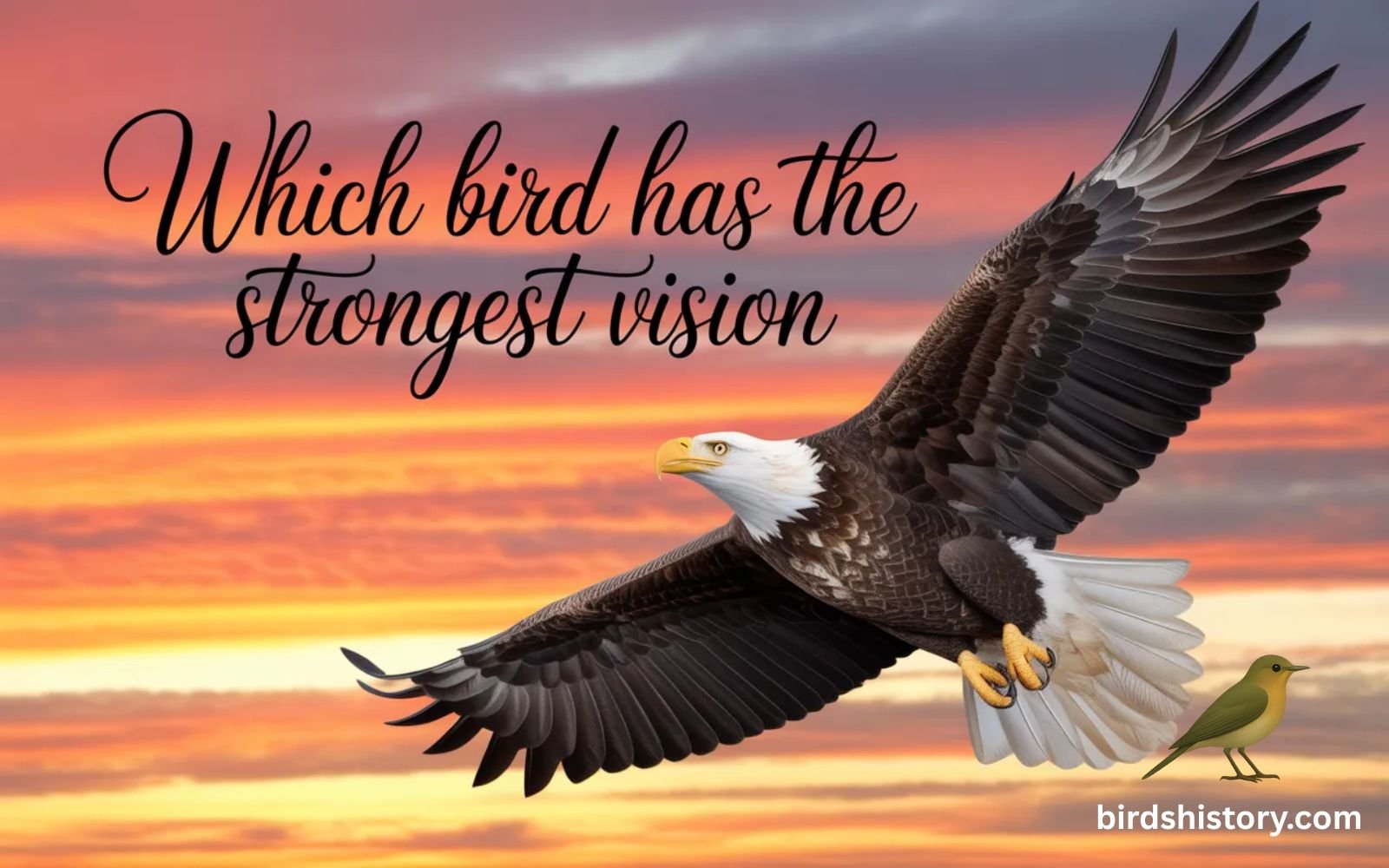
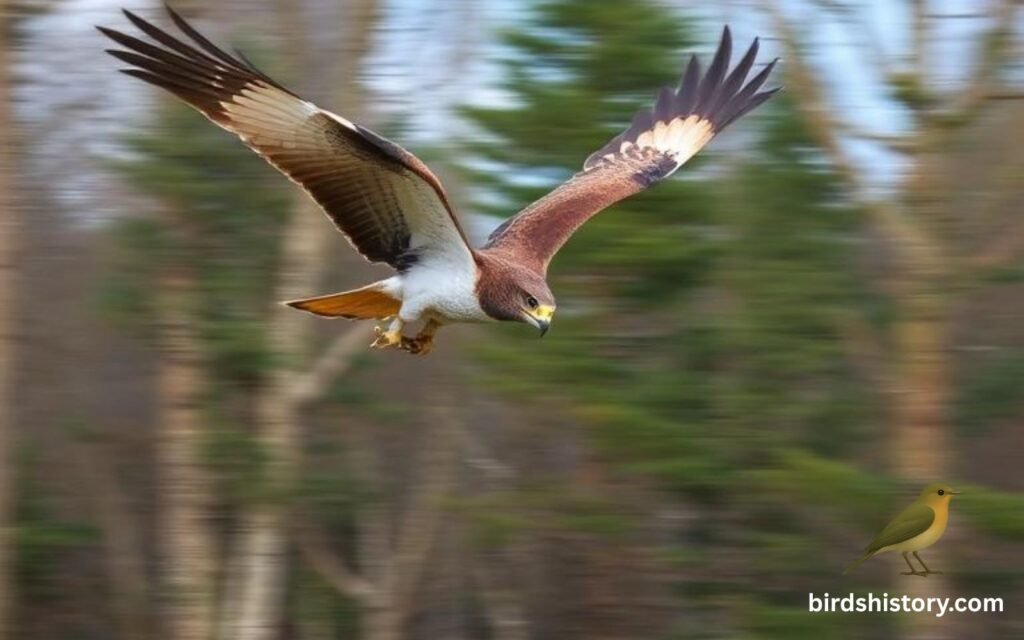
Raptors eyesight is legendary, with species like eagles, hawks, and falcons at the top of the list. These birds of prey can detect prey from extreme distances, sometimes over two miles, due to distance acuity and visual processing speed. Large eyes, dense cone cells, and dual fovea allow them to perceive fine details, track movement, and hunt efficiently during the day. Their eyes also have high retinal density, which provides clarity and focus unmatched by most other animals.
Other diurnal birds like herons and kingfishers also show remarkable motion detection and color perception. Herons, for example, can spot fish underwater by compensating for light refraction, while kingfishers calculate motion prediction when diving at incredible speeds. Even birds with monocular vision, like woodcocks, can scan large areas efficiently, demonstrating that strong daytime vision isn’t just for large raptors.
| Bird Species | Vision Type | Max Distance Vision | Special Adaptations |
|---|---|---|---|
| Golden Eagle | Binocular | 2+ miles | Dual fovea, UV detection |
| Peregrine Falcon | Binocular | 1.5 miles | High-speed vision, motion prediction |
| American Kestrel | Binocular | 1 mile | UV-reflective trails, microsaccadic movement |
| Heron | Binocular | 500 feet | Motion detection underwater, light refraction adjustment |
| Kingfisher | Binocular | 400 feet | High-speed dive tracking, distance acuity |
Birds with the Strongest Night Vision
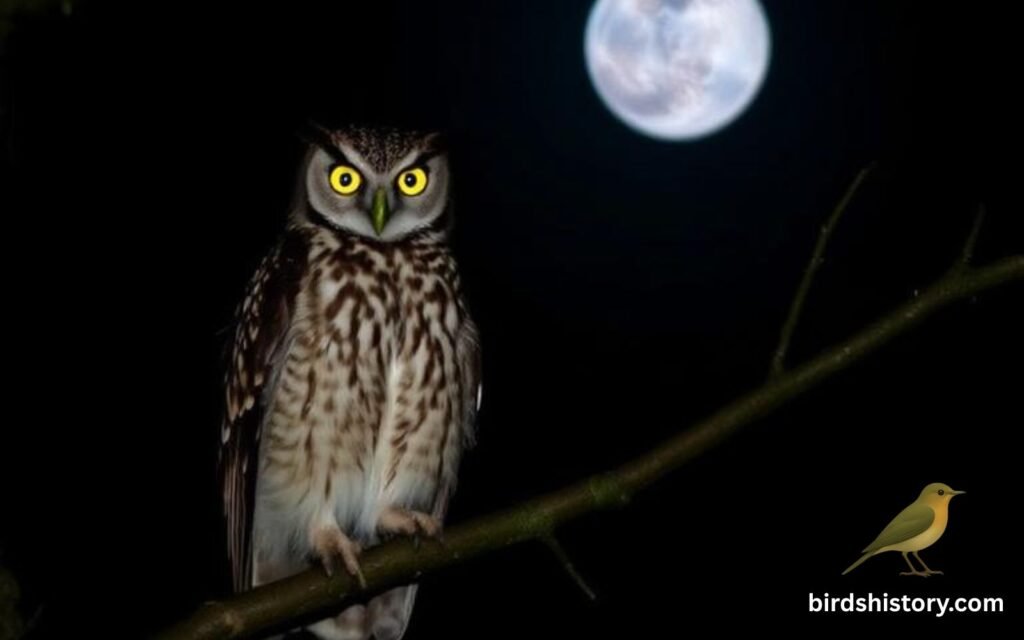
Some nocturnal birds have adapted their eyes for hunting in near darkness. Owls, for instance, have tubular eyes filled with rod cells that excel in low-light threshold conditions. These night vision birds possess a tapetum lucidum, a reflective layer that enhances light gathering, allowing them to see prey clearly even in complete darkness. Owls also have binocular depth perception, which helps them silently swoop down on prey during night hunting.
Other birds like nightjars and some herons also exhibit impressive nocturnal capabilities. Their motion-prediction in birds allows them to detect insects and small mammals at night. The field of view in these species is wide, and the combination of rod cells and retinal density ensures maximum visibility in dark conditions. Even small birds like some owlets can spot movement from tens of meters away, demonstrating that birds that can see in the dark are highly specialized predators, perfectly adapted for nocturnal survival.
The Golden Eagle: Distance Vision Like No Other
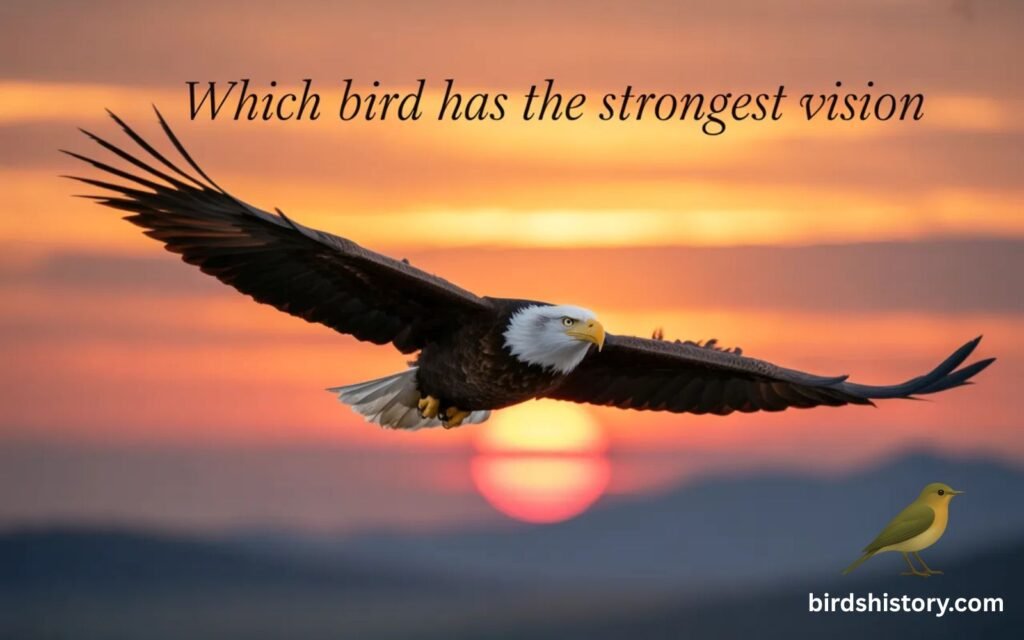
The golden eagle is often celebrated as the ultimate in distance acuity. Its massive eyes, coupled with dual fovea, allow it to detect prey from over two miles above the ground. This predator combines binocular depth perception with a wide field of view, making it an apex hunter among birds of prey. Golden eagles rely on motion detection to spot even subtle movements of rabbits or foxes from high altitudes.
Their visual processing is extraordinarily fast, enabling them to track moving prey while soaring or diving at high speeds. The eagle eyesight is enhanced by UV-reflective trails that highlight animal urine, helping it locate hidden prey. This combination of size, structure, and high-speed vision makes the golden eagle not only a master of the sky but a benchmark for birds with strongest eyesight worldwide.
The Peregrine Falcon: Speed Meets Precision
The peregrine falcon is famous for its breathtaking speed and razor-sharp vision. With falcon vision finely tuned for hunting, it can spot prey from over 1.5 miles away while in flight. Its eyes contain dense cone cells and dual fovea, allowing high-speed vision necessary to track birds during stoops, which can reach over 200 miles per hour. Motion-prediction in birds ensures that a peregrine can anticipate the trajectory of its prey mid-air, making it one of the most efficient hunters on Earth.
In addition to speed, the falcon’s distance acuity is enhanced by UV-reflective trails, which help identify prey markings invisible to humans. Its binocular depth perception allows precise judgment of distance during rapid dives. Even smaller prey can be targeted with deadly accuracy, showcasing how birds of prey combine visual processing, dynamic light adaptation, and microsaccadic eye movement to dominate the skies.
The American Kestrel: Small But Mighty Eyesight
The American kestrel is a small raptor that packs an incredible punch in terms of vision. Despite its tiny size, it has exceptional kestrel vision, capable of detecting small mammals, insects, and even movements in grass from a mile away. Its eyes include a visual streak, which increases horizontal scanning ability, and a nictitating membrane that protects the eyes while maintaining clarity during fast dives.
Kestrels also use UV-reflective trails to locate prey, a feature shared with larger raptors like falcons and eagles. Their binocular depth perception is strong enough to judge exact landing spots, while motion detection allows them to lock onto even the faintest movement. This combination of size efficiency, speed, and retinal density makes the American kestrel one of the most remarkable examples of birds with strongest eyesight among small predatory birds.
How Color and UV Vision Enhance Bird Hunting
Birds with color vision and birds with UV vision can detect prey and environmental cues invisible to humans. Raptors, including eagles and kestrels, see ultraviolet light, which allows them to track urine trails, feathers, and even insect markings. This gives them a huge advantage in hunting, as visual processing of UV-reflective trails turns even the most camouflaged prey into a visible target.
Beyond UV detection, color perception improves accuracy when hunting among trees, grass, or water. For instance, herons rely on color perception to spot fish under the water surface, while hummingbirds use color perception to identify nectar-rich flowers. This combination of motion detection, distance acuity, and polarization sensitivity ensures that predatory birds excel in both complex terrain and open skies.
Binocular vs Monocular Vision: Which Birds See Best?
Birds differ in field of view and depth perception depending on eye placement. Birds with binocular vision, like hawks and eagles, have binocular depth perception, allowing them to precisely judge distance when hunting. Their eyes face forward, and fovea provide sharp focus for both near and far objects. Raptors eyesight is optimized for this type of vision, giving them an edge over most other birds.
In contrast, birds with monocular vision, such as pigeons and woodcocks, have eyes on the sides of their heads. This gives them monocular wide field vision, enabling them to detect predators from almost any angle but sacrificing depth perception. While less effective for hunting, it provides superior motion detection and 360-degree vision, showing that birds with strongest eyesight are adapted to their unique ecological roles.
| Vision Type | Birds Examples | Advantages | Disadvantages |
|---|---|---|---|
| Binocular | Eagles, Hawks, Kestrels | Accurate depth perception, precise hunting | Limited peripheral vision |
| Monocular | Pigeons, Woodcocks | Wide field of view, predator detection | Less accurate distance judgment |
Birds That Can Spot Prey from Miles Away
Distance acuity is a defining feature of several raptors. Eagles, falcons, and hawks can see prey from over a mile away, thanks to dual fovea, high retinal density, and specialized photoreceptor cells. They can detect subtle motion-prediction in birds, like rustling grass or shifting shadows, to locate animals that remain invisible to humans.
Hunting success also relies on dynamic light adaptation. Raptors adjust quickly to changing light, whether soaring high above open plains or diving through shaded forests. For example, a golden eagle uses UV-reflective trails to follow rabbit paths, while a peregrine falcon tracks flocks of birds mid-air using its high-speed vision. These adaptations prove why birds of prey dominate the skies and why they are often cited as birds with the strongest eyesight.

Unique Vision Abilities in Small Birds
Not all exceptional vision belongs to large predators. Hummingbird vision allows them to hover while detecting fast-moving insects and nectar-rich flowers with extreme precision. Kingfisher eyesight is adapted for spotting fish underwater from above, compensating for light refraction with precise visual processing. Even small birds like woodcocks use monocular wide field vision to avoid predators while searching for insects on the forest floor.
Unique adaptations include microsaccadic eye movement, which stabilizes vision during rapid movements, and polarization sensitivity, helping birds detect water surfaces and food sources. These features prove that birds with strongest eyesight are not limited to large raptors, and many smaller species use distance acuity and motion detection in clever ways to survive.
Common Questions About Which Bird Has the Strongest Vision
Which Bird Has the Strongest Vision?
The golden eagle and American kestrel are often considered the birds with the strongest vision, combining distance acuity, UV vision, and motion detection to spot prey from miles away.
Can birds see at night?
Yes, nocturnal birds like owls and tawny owls have large eyes with many rod cells and a tapetum lucidum, allowing them to hunt efficiently in very low light.
Which bird has king sight?
The kingfisher is known for its exceptional eyesight, especially underwater. It uses binocular vision while diving and monocular vision in the air to catch fish precisely.
Which birds have 360 vision?
Birds like the American woodcock have 360-degree vision thanks to eyes positioned high on the head, allowing them to detect predators while foraging.
Who has better eyesight, an eagle or a falcon?
Eagles have superior distance acuity and binocular depth perception, while peregrine falcons excel in high-speed vision and motion detection during fast dives.
Which bird has the sharpest vision?
The golden eagle is credited with the sharpest vision, with extremely high retinal density and fovea specialization, allowing it to spot prey over two miles away.
Who has the world’s best eyesight?
The American kestrel is considered to have the most functionally complete vision, integrating UV vision, polarization sensitivity, and precise motion-prediction in birds.
Which bird has the most powerful eyes?
Owls, particularly the tawny owl, have the most powerful eyes at night due to massive rod cell density, low-light threshold, and tapetum lucidum reflecting light.
Which animal has the poorest vision?
Animals like the mole have extremely poor eyesight, relying mostly on touch and smell rather than vision to navigate underground.
What animal has 1200 eyes?
The scallop has around 1,200 tiny eyes along its shell, which can detect light, motion, and shadows, helping it sense predators and navigate underwater.
Bird Vision vs Human Vision: Who Sees Better?
Comparing bird vision to human vision highlights the incredible specialization of predatory birds. Humans rely on a single fovea and limited visual streak, whereas eagles and hawks have dual fovea, dense photoreceptor cells, and retinal density far beyond ours. Their distance acuity allows them to spot prey from miles away, while humans struggle to see objects clearly beyond a few hundred feet.
Even in color perception, birds with color vision surpass humans. Many birds can detect ultraviolet light, see polarization sensitivity, and track subtle movements that are invisible to the human eye. Birds with 360-degree vision like woodcocks or pigeons detect predators from nearly every angle, whereas humans must turn their heads. In every aspect—from motion detection to binocular depth perception—birds show why birds with strongest eyesight reign supreme in the visual world.
Conclusion: Which Bird Truly Has the Strongest Vision?
After exploring eagles, falcons, kestrels, and even small birds like hummingbirds, it’s clear that the question isn’t simple. For sheer distance acuity, golden eagles and hawks lead, spotting prey from miles away. For speed and precision, peregrine falcons excel, combining high-speed vision, motion-prediction in birds, and binocular depth perception to dominate airborne hunting. Small birds like kestrels and kingfishers prove that retinal density and UV-reflective trails can make tiny species equally impressive hunters in their niche.
Ultimately, the best bird vision depends on the type of vision required—diurnal birds thrive in daylight hunting with color perception and distance acuity, while nocturnal birds like owls excel in low-light threshold, rod cell function, and night hunting. Understanding these variations highlights nature’s ingenuity in designing eyes optimized for survival, motion detection, and precision, confirming that birds with strongest eyesight are among the most extraordinary creatures on Earth.