
The Gray Winged Trumpeter: Amazon’s Secretive Forest Sentinel
The rainforests of South America are filled with mysterious birds, but one of the most unusual is the Gray winged Trumpeter. At first glance, it may not seem as flashy as a toucan or as colorful as a macaw. Yet this shy, ground-dwelling bird has its own set of fascinating traits that make it worth learning about. Found in the dense forests of the Amazon Basin, the Gray-winged Trumpeter is known for its secretive lifestyle, strange social behaviors, and haunting calls.
What makes it interesting? Unlike many tropical birds that perch high in the canopy, this bird spends most of its life walking through the undergrowth in small family groups. It also plays an important role in the ecosystem by helping control insect populations and spreading seeds. A surprising fact is that despite its turkey-like body and chicken-like habits, the Gray-winged Trumpeter is actually more closely related to cranes and rails. That unusual evolutionary history adds to its intrigue.
Let’s take a closer look at this little-known bird, exploring everything from its scientific classification to its behavior, threats, and conservation.
Gray winged Trumpeter Taxonomy / Classification
Understanding where the Gray-winged Trumpeter fits in the avian world helps us see why it’s so unique.
- Common Name: Gray winged Trumpeter
- Scientific Name: Psophia crepitans
- Family: Psophiidae
- Order: Gruiformes
- Class: Aves
Also read: /crimson-topaz-hummingbird/
This order also includes cranes and rails, which explains some of the similarities in their body structure and behavior. Within its genus Psophia, there are several species of trumpeters, each with slightly different ranges and feather coloring. The Gray-winged Trumpeter is the most common of its kind, and its modest gray flight feathers distinguish it from its relatives.
Gray winged Trumpeter Physical Description
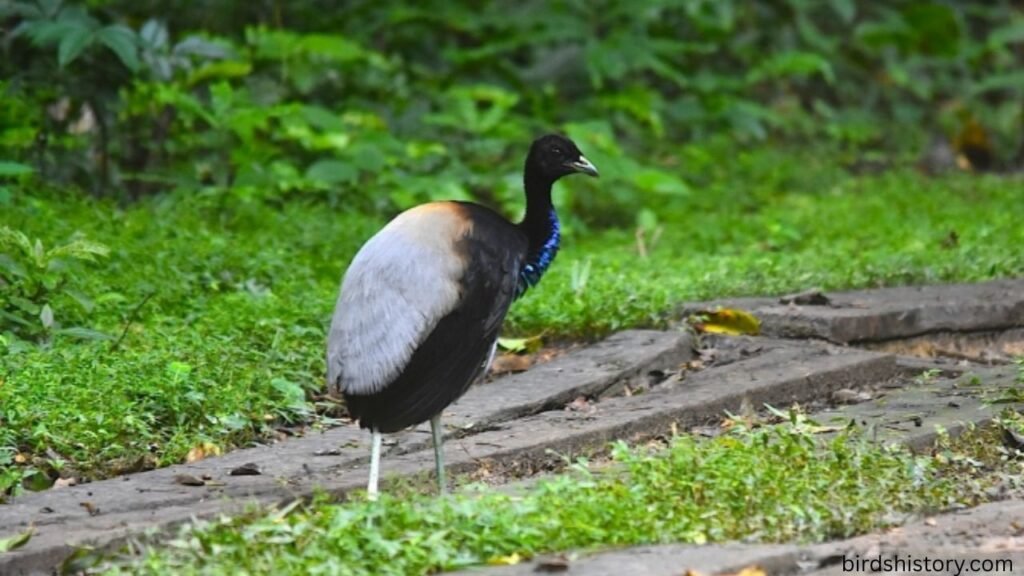
The Gray-winged Trumpeter has a body that looks like a mix between a turkey and a guinea fowl, but with an elegance all its own.
- Size: About 45–52 cm (18–20 inches) long, weighing 1–1.5 kg.
- Coloration: The body is mostly black with an iridescent sheen on the back and breast that can appear green or purple in the right light. The wings are dusky gray, which gives the species its common name.
- Beak: Short, slightly curved, and dark.
- Tail: Very short and often hidden under body feathers.
- Legs: Long and strong, built for walking and running rather than perching.
- Male vs Female: Males and females look alike, with little sexual dimorphism.
One of their most notable traits is their posture. Trumpeters often walk upright with a dignified stride, almost like they’re pacing a forest stage.

Habitat and Range of Gray winged Trumpeter
The Gray-winged Trumpeter is a bird of the Amazon Basin, thriving in the dense lowland rainforests.
- Countries: Brazil, Venezuela, Colombia, Ecuador, Guyana, Suriname, and French Guiana.
- Preferred Habitat: Moist, undisturbed tropical forests with thick undergrowth and fallen logs. They prefer primary forests but will also use secondary forests if undisturbed.
- Range Behavior: Non-migratory. Instead of traveling long distances, they stick to territories they defend in groups.
These birds are rarely seen in open spaces or near humans, which is why many travelers to the Amazon may never encounter one, even if it’s nearby.
Diet and Feeding Habits
Gray-winged Trumpeters are omnivorous opportunists.
- This animal is an opportunistic feeder that eats a variety of things, such as fruits, seeds, insects, spiders, small reptiles, and even amphibians.
- Feeding Method: They forage on the forest floor, using their beaks to probe leaf litter. They are especially drawn to fruit that has fallen from trees.
- Interesting Behavior: Trumpeters sometimes follow monkey troops, waiting for them to drop fruit. They also feed on insects that try to escape from swarms of army ants.
This behavior makes them an important part of the ecosystem, as they help with both insect control and seed dispersal.
Behavior and Lifestyle
The Gray-winged Trumpeter is a social bird, living in cooperative groups.
- Social Structure: Groups usually contain one breeding male, several females, and subordinate males.
- Flight Style: Rarely flies. If threatened, it prefers to run, but it can make short, noisy flights to escape danger.
- Calls: Its name comes from its deep, resonant “trumpeting” calls, which echo through the forest like a muffled horn. These calls help groups stay in contact and defend territory.
- Mating Rituals: Males may engage in subtle displays of posture and calling to attract females and establish dominance.
They’re not flashy dancers like manakins or birds-of-paradise, but their coordinated group movements and calls create a kind of understated performance in the rainforest.
Reproduction and Lifespan
The cooperative breeding system of Gray-winged Trumpeters makes their reproduction process quite interesting.
- The breeding season typically occurs during the rainy season, as this is when food is most plentiful.
- Nesting: Nests are built in tree cavities or dense vegetation, hidden from predators.
- Eggs: Females typically lay 2–4 eggs, pale and slightly speckled.
- Incubation: About 27–30 days. Females share incubation duties, while males guard the territory.
- Newborn chicks are precocial, meaning they can walk shortly after hatching. They are cared for by the entire group, not just the parents.
- Lifespan: Around 15–20 years in the wild, potentially longer in captivity.
This cooperative care gives chicks a better chance of survival in the predator-filled rainforest.
Predators and Threats
The Gray-winged Trumpeter faces many dangers in its forest home.
- Natural Predators: Jaguars, ocelots, tayras, large snakes, and raptors like hawk-eagles. Eggs and chicks can be attacked by smaller predators, such as monkeys and coatis.
- Environmental Threats: Deforestation is the biggest risk. As Amazonian forests shrink, so does their habitat.
- Human Impact: Hunting pressure is relatively low, since their meat is not highly valued, but they are sometimes killed when spotted near settlements.
Their reliance on intact forest makes them particularly sensitive to habitat destruction.
Gray winged Trumpeter Conservation Status
The International Union for Conservation of Nature (IUCN) Red List currently classifies the Gray-winged Trumpeter, with the scientific name Psophia crepitans, as a species of “Least Concern.” This means it is not immediately at risk of extinction, thanks to its broad distribution.
However, local populations can decline quickly where deforestation and forest fragmentation occur. For the species to survive, conservationists say that the best approach is to protect vast areas of the Amazon rainforest.
Interesting Facts About Gray winged Trumpeter
- Trumpeters are named for the trumpet-like calls they produce, which carry long distances through the jungle.
- They are excellent watchdogs: Indigenous communities sometimes tame them to guard villages, as they give loud alarm calls when strangers approach.
- Despite looking somewhat like domestic fowl, their closest relatives are cranes, not chickens.
- They play an important role in seed dispersal, helping maintain rainforest diversity.
- Their iridescent feathers shimmer in shades of green, purple, and blue, which can look spectacular under sunlight filtering through the canopy.
Conclusion
The Gray-winged Trumpeter may not be the first bird that comes to mind when you think of the Amazon, but it deserves a spot among the rainforest’s stars. From its cooperative family structure to its eerie trumpeting calls, this species is a reminder of how much biodiversity hides in the shadows of the forest floor. Protecting these birds means protecting the Amazon itself—a home to countless creatures, many of which remain just as mysterious.
Must Read: /turquoise-tanager-history/
Learning about the Gray-winged Trumpeter isn’t just about appreciating one species. It’s about understanding the delicate web of life in one of Earth’s most vital ecosystems.

FAQs About Gray winged Trumpeter
1. What is the Gray-winged Trumpeter’s scientific name?
Psophia crepitans.
2. Where can you find Gray winged Trumpeters?
In the Amazon Basin, across Brazil, Venezuela, Colombia, Ecuador, Guyana, Suriname, and French Guiana.
3. Do Gray winged Trumpeter fly often?
Rarely. They prefer to walk or run and only fly short distances when threatened.
4. What do Gray winged Trumpeter eat?
Fruits, seeds, insects, and small reptiles.
5. Are Gray winged Trumpeter social or solitary?
They are highly social, living in groups with cooperative care for chicks.
6. How do Gray winged Trumpeter communicate?
With loud trumpet-like calls that echo through the rainforest.
7. Are Gray winged Trumpeter endangered?
Currently, they are listed as Least Concern, but deforestation poses future risks.
8. How long do Gray winged Trumpeter live?
About 15–20 years in the wild.
9. Do people hunt them?
Not heavily, though they may be killed locally near settlements.
10. Why are they important to the ecosystem?
They disperse seeds and help maintain rainforest biodiversity.