The Blue and Yellow Macaw: A Vibrant Icon of the Tropics
It’s hard for any other bird to match the captivating beauty and charm of the Blue and Yellow Macaw. This parrot’s vibrant feathers, strong wings, and distinct calls have made it one of the most famous and adored tropical birds globally. In the verdant rainforests of South America, this bird is native, and its flocks paint the green treetops with vibrant streaks of blue and gold.
Beyond their looks, Blue and Yellow Macaws are fascinating for their intelligence and strong pair bonds. These birds can mimic human speech, live for decades, and maintain lifelong partnerships with their mates. One surprising fact? A healthy macaw can live longer than many people—sometimes up to 70 years in captivity.
In this guide, we’ll explore everything about the Blue and Yellow Macaw, from its classification and behavior to its role in the ecosystem and cultural symbolism.
Taxonomy / Classification
- The common name for this bird is the Blue and Yellow Macaw, but it is also frequently referred to as the Blue and Gold Macaw.
- Scientific Name: Ara ararauna
- Family: Psittacidae (the parrot family)
- Order: Psittaciformes
- Class: Aves
Also read: /crimson-topaz-hummingbird/
The Blue and Yellow Macaw belongs to the Ara genus, which includes several large macaws such as the Scarlet Macaw (Ara macao) and the Green-winged Macaw (Ara chloropterus). These birds are closely related but differ in color patterns and range.
Physical Description
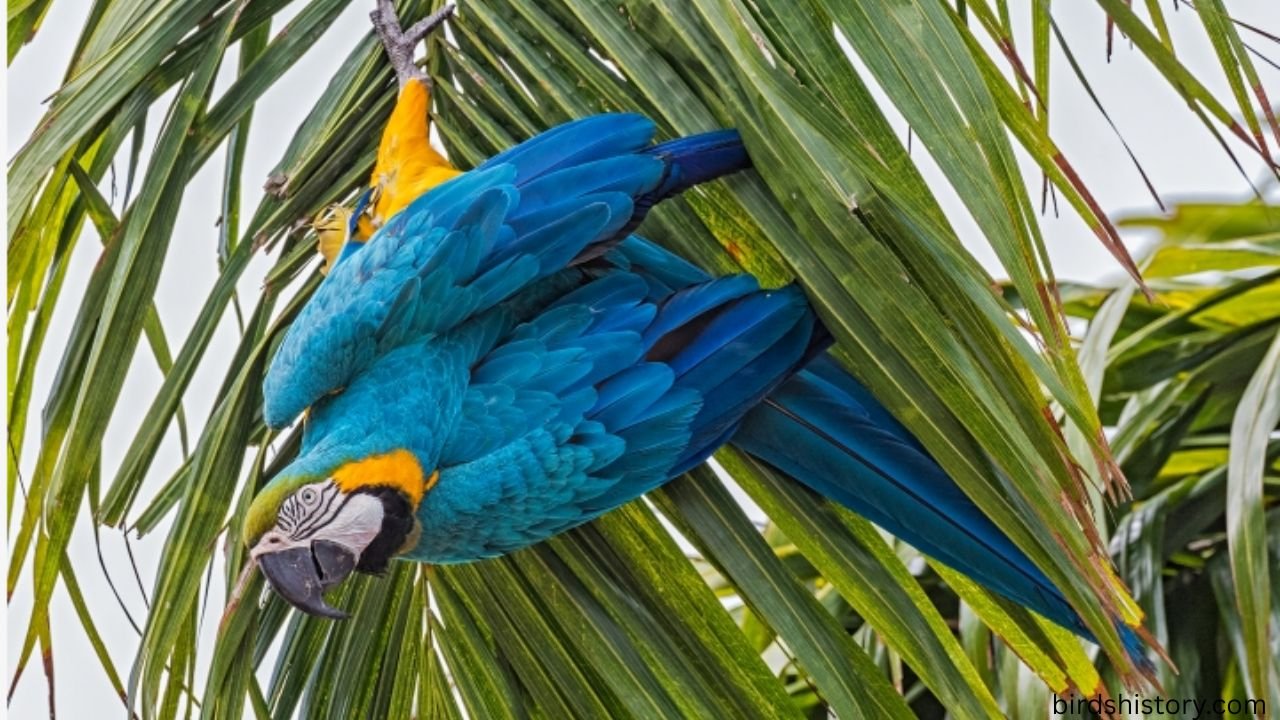
The Blue and Yellow Macaw is a large, striking parrot with features that make it instantly recognizable.
- Size: Around 76–86 cm (30–34 inches) in length.
- Wingspan: Roughly 104–114 cm (41–45 inches).
- Weight: Typically 0.9–1.5 kg (2–3 lbs).
- Coloration:
- Upper parts: Bright turquoise-blue wings and back.
- Underparts: Vivid golden-yellow chest and belly.
- Face: White, bare skin patch lined with thin black feather stripes.
- Throat: Black “beard” marking below the beak.
- Its beak is large, black, and powerful, which allows it to crack open tough nuts.
- Tail: Long and pointed, with shades of blue and green.
Sexual dimorphism: Males and females look almost identical, which makes sexing difficult without genetic tests.
Unique traits: Their bare white face patches are unique identifiers—each macaw has slightly different feather lines, almost like a fingerprint.

Habitat and Range
The Blue and Yellow Macaw is native to South America and can be found across a wide range:
- This species can be found in a number of countries, including Venezuela, Peru, Brazil, Bolivia, Paraguay, Guyana, Suriname, and the northern part of Argentina.
- Preferred Habitats:
- Tropical and subtropical rainforests
- Swampy areas and gallery forests near rivers
- Savannahs with scattered tall trees
- Altitude: Generally found below 500 meters but may inhabit elevations up to 1,000 meters.
They are non-migratory, but they do move locally in search of food or nesting sites, often traveling in small family groups or larger flocks.
Diet and Feeding Habits
Besides their striking beauty, Blue and Yellow Macaws are exceptionally intelligent birds.
- Main Foods: Fruits, nuts, seeds, and berries.
- Special Preference: They are especially known for eating palm nuts, which their powerful beaks can easily crack.
- Clay Licks: One of their most fascinating behaviors is visiting clay licks along riverbanks. Here, macaws eat mineral-rich clay that neutralizes toxins from certain fruits and seeds.
- Feeding Style: They often hold food with one foot (parrots are zygodactyl, meaning two toes face forward and two backward), using it almost like a human hand.
This feeding behavior not only sustains the bird but also plays a role in seed dispersal, making macaws crucial to rainforest regeneration.
Behavior and Lifestyle
Blue and Yellow Macaws are not only beautiful but also highly intelligent.
- Social Nature: They are highly social, often traveling in pairs, small groups, or large flocks of 25 or more.
- Pair Bonding: Mates are monogamous and often fly side by side, touching wings or calling loudly to each other.
- Communication:
- Loud, harsh squawks used for long-distance contact.
- Gentle vocalizations between pairs.
- Ability to mimic human speech in captivity.
- Flight Style: Strong, fast fliers with steady wingbeats, capable of covering long distances.
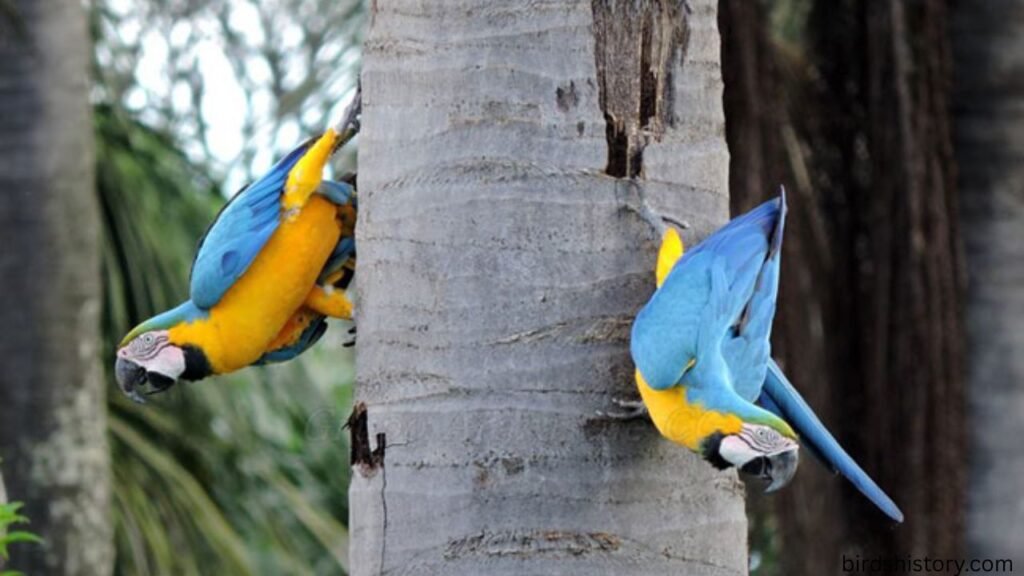
- Nesting Habits: Prefer cavities in tall trees or palm trunks, often near water.
Their playful personalities make them popular in the pet trade, but in the wild, this intelligence is essential for survival.

Reproduction and Lifespan
- Breeding Season: Typically in the rainy season when food is abundant (varies by region).
- To nest, these pairs choose tree cavities that are located high up in the air.
- Clutch Size: 2–3 eggs, though usually only one or two chicks survive.
- Incubation: Around 25–28 days, performed mainly by the female while the male provides food.
- Chick Development: Young macaws fledge at about 3 months but remain dependent on parents for several more weeks.
Lifespan:
- Wild: Around 30–35 years.
- Captivity: With proper care, they can live 50–70 years, making them lifelong companions.
Predators and Threats
The Blue and Yellow Macaw, like many tropical birds, faces natural predators and human-caused dangers.
- Natural Predators:
- Large raptors like harpy eagles and hawks.
- Snakes and monkeys may raid nests for eggs or chicks.
- Human Threats:
- Deforestation: Logging, agriculture, and urban expansion reduce nesting trees.
- Illegal Pet Trade: Poaching of eggs and chicks remains a problem despite protections.
- Climate Change: Altered rainfall patterns affect food supply and breeding.
Conservation Status
The IUCN Red List currently lists the Blue and Yellow Macaw as Least Concern, thanks to its wide distribution. However, populations are declining in some areas due to habitat destruction and poaching.
Conservation Efforts:
- Protected areas in the Amazon and Pantanal.
- Community-based conservation projects in Brazil and Peru.
- Breeding and reintroduction programs in Argentina, where macaws had disappeared but are now being restored.
Interesting Facts
- When kept as pets, they are known to be exceptional talkers and can learn to say many different words and phrases.
- Strong Beaks: Their beaks exert hundreds of pounds of pressure—strong enough to crack Brazil nuts.
- Cultural Symbol: In many South American cultures, macaws symbolize freedom, strength, and vibrant life.
- Long Flights: In the wild, they may travel up to 25 miles in a day searching for food.
- Family Bonds: Macaw pairs are so close that if one dies, the other may become depressed.
- Popular in Art: Their bright feathers often feature in indigenous crafts and ceremonial dress.
Conclusion
The Blue and Yellow Macaw is more than just a bird—it’s a symbol of the Amazon’s richness and resilience. Its dazzling plumage, intelligence, and strong social bonds make it one of the most remarkable creatures on Earth. Yet, as with many rainforest animals, its survival depends on protecting the habitats it calls home.
By learning about and appreciating this bird, we also highlight the importance of safeguarding tropical forests for future generations.
FAQs
1. Where can you find Blue and Yellow Macaws in the wild?
They are native to South America, from Venezuela and Brazil to northern Argentina.
2. Why do they visit clay licks?
To eat mineral-rich clay that neutralizes toxins from their diet.
3. How long do Blue and Yellow Macaws live?
30–35 years in the wild, up to 70 in captivity.
4. Do they talk like parrots in movies?
Yes, they can mimic human speech with training, though not all learn equally well.
5. What do they eat?
Mainly fruits, nuts, seeds, and berries, with a preference for palm nuts.
6. Are they endangered?
Although they are currently categorized as “Least Concern,” these animals are still threatened by habitat loss and illegal poaching.
7. Do males and females look different?
No, they look alike, making it hard to distinguish them visually.
8. How big is a Blue and Yellow Macaw?
Measuring between 30 and 34 inches in length, this bird has a wingspan that can reach up to 45 inches.
9. Are they good pets?
They can be affectionate and intelligent, but they require significant space, care, and commitment.
10. Why are they important to the ecosystem?
They disperse seeds, helping forests regenerate and remain healthy.