Spix’s guan: Secrets of the Rainforest Bird
The Spix’s Guan is one of those forest birds that may not be as famous as toucans or parrots but plays a vital role in tropical ecosystems. Belonging to the guan family, this species is a large, fruit-eating bird found in the lush forests of South America. The Spix’s Guan is a captivating bird for both scientists and birdwatchers due to its remarkable feathers, loud vocalizations, and significant role in the ecosystem.
What makes it especially interesting is that Spix’s Guan is not just another rainforest bird—it is a key seed disperser. By eating fruits and dropping seeds across wide areas, it helps regenerate the forests it inhabits. Named after the German naturalist Johann Baptist von Spix, this bird represents both the beauty and fragility of South American biodiversity.
One surprising fact about Spix’s Guan is its ability to thrive in both primary rainforests and disturbed habitats, proving its resilience in the face of environmental change. Still, human pressures remain a serious concern.
Taxonomy / Classification
- Common Name: Spix’s Guan
- Scientific Name: Penelope jacquacu
- Family: Cracidae
- Order: Galliformes
- Class: Aves
Also read: /the-great-spotted-kiwi/
Spix’s Guan belongs to the Cracidae family, which also includes chachalacas and curassows. These birds are often compared to turkeys in appearance but are uniquely adapted to tropical forests.
Physical Description
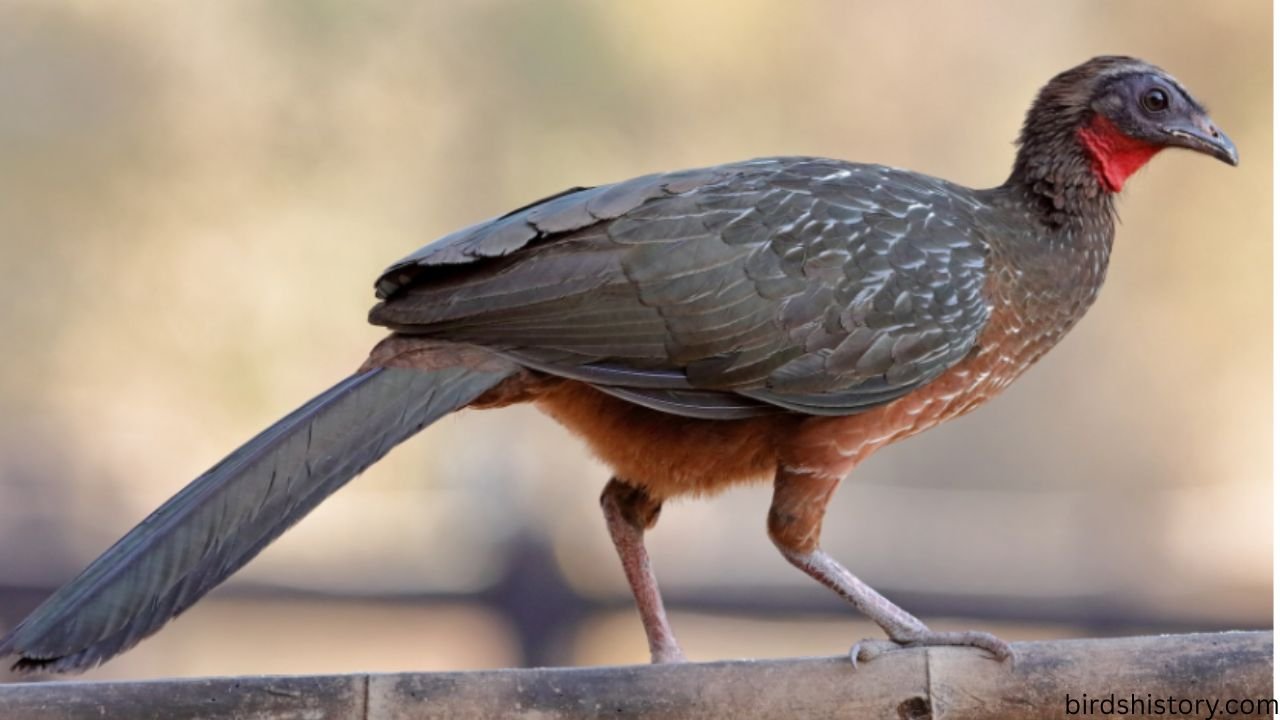
Spix’s Guan is a medium-to-large bird, measuring 65–75 cm (25–30 inches) in length and weighing about 1.3–1.8 kg (2.8–4 lbs).
Key Features:
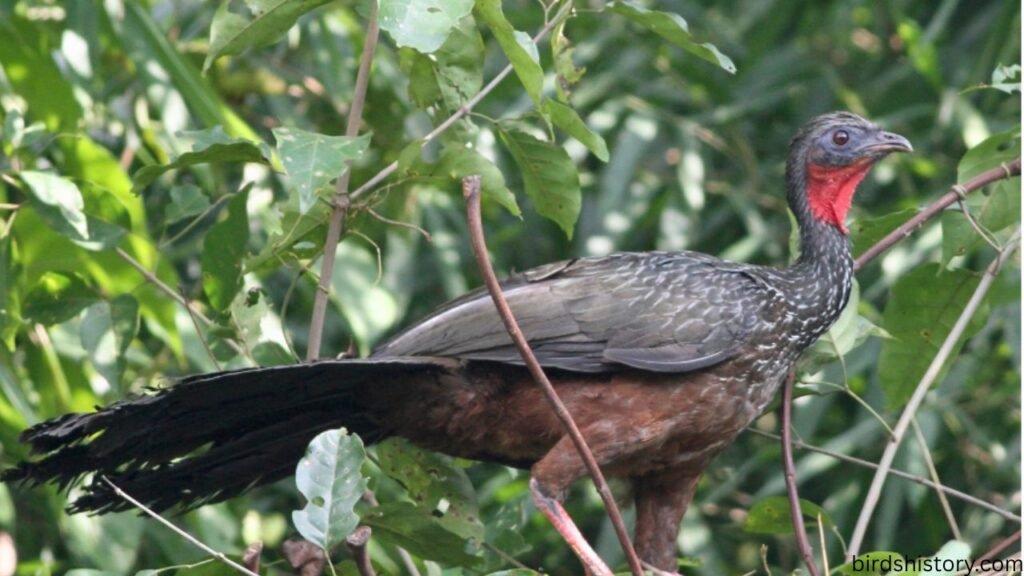
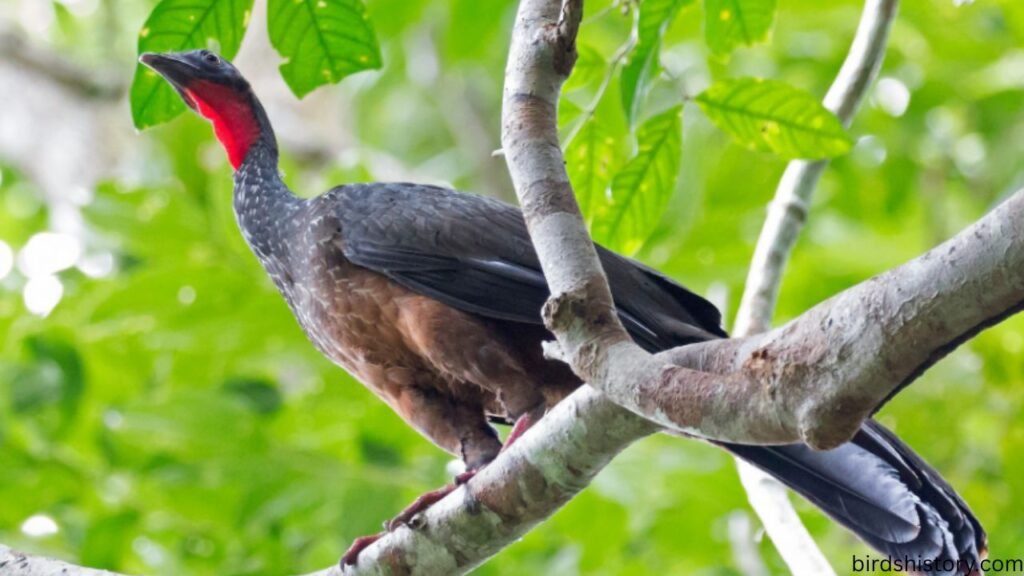
- Plumage: Dark brown overall with a slight greenish gloss on the wings and back. The feathers are often finely edged with lighter shades, giving it a scaled appearance.
- Head and Neck: Bare skin around the throat is reddish, a common trait in guans.
- Beak: Short, curved, and strong—perfect for fruit consumption.
- Tail: Long and broad, aiding in balance when moving through branches.
- Legs: Strong, with adaptations for perching and climbing among trees.
Male vs. Female:
- Males and females look quite similar, with subtle differences in size—the males being slightly larger.
- Both sexes share the same coloration and throat patch.
Its appearance may not be as flamboyant as a macaw, but its elegant earthy tones help it blend into the forest canopy, where it spends most of its time.
Habitat and Range
Spix’s Guan has an extensive range in tropical South America.
- This species is native to several South American countries, including Brazil, Colombia, Ecuador, Peru, Bolivia, Venezuela, and Guyana.
- Preferred Habitat:
- Lowland tropical rainforests
- Swampy forests
- Flooded river forests (varzea)
- Secondary forests and disturbed habitats
- Altitude: Typically below 1,200 meters, though occasionally found higher.
- Migration: The species is non-migratory, staying within its range year-round.
Its wide distribution and adaptability allow it to occupy both pristine and human-modified forests, though it is still vulnerable to hunting.
Diet and Feeding Habits
Spix’s Guan is a frugivore, meaning fruit makes up the majority of its diet. However, it also consumes other items depending on availability.
Diet Includes:
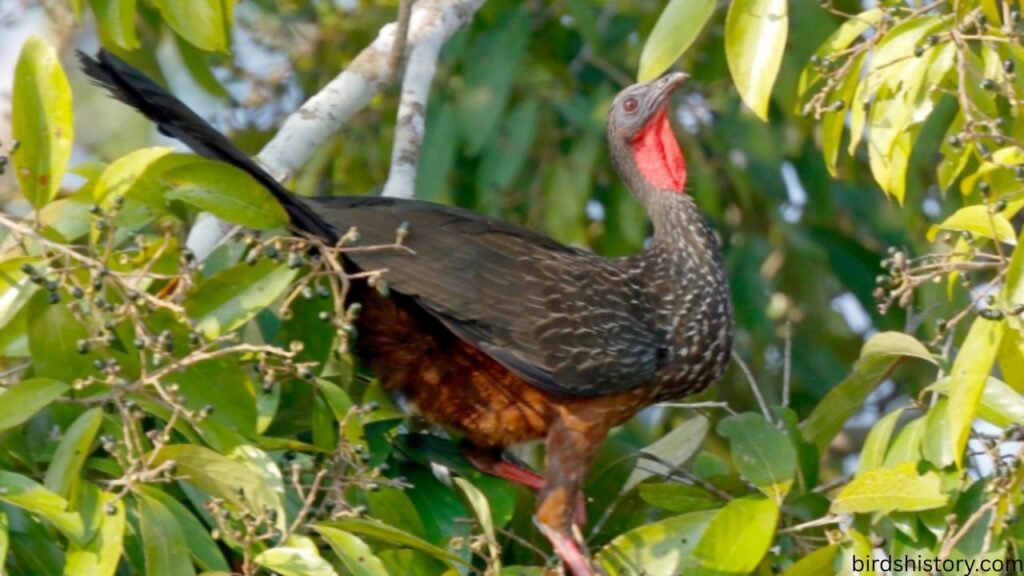
- Fruits and berries
- Seeds
- Leaves and buds
- Occasional insects
Feeding Behavior:
- Forages mostly in trees but sometimes descends to the ground.
- This bird is an essential part of the ecosystem because it helps to spread seeds. By eating fruits and dropping seeds across wide distances, it helps maintain rainforest diversity.
- Often feeds in small groups, especially around fruiting trees.
Their feeding habits make them crucial for forest regeneration, placing them among the keystone species of their ecosystem.
Behavior and Lifestyle
Spix’s Guan is generally a social bird, often found in pairs or small family groups.
- Activity: Diurnal (active during the day), spending mornings and afternoons foraging in trees.
- Flight: Strong but short; it usually flies from tree to tree with noisy wingbeats.
- Vocalizations: Known for loud, hoarse calls that carry across the forest. Their calls are often described as rough and repetitive, used for communication and territory defense.
- Roosting: Spends nights perched high in trees, safe from ground predators.
- Mating Rituals: Males may engage in vocal displays and physical posturing to attract females.
These birds are often shy around humans, making them a rewarding but challenging species to observe in the wild.
Reproduction and Lifespan
Spix’s Guan follows typical galliform breeding patterns.
- Breeding Season: Often linked to the rainy season, when food is abundant.
- Nesting:
- The nests, typically located in trees or shrubs, are constructed from sticks and have a lining of leaves.
- Sometimes nests in dense vegetation for extra camouflage.
- Eggs:
- Lays 2–3 eggs, cream or whitish in color.
- Incubation period lasts about 28 days.
- Parental Care: Females are the primary incubators, but both parents may care for chicks after hatching.
- Chicks: Precocial (born with down and able to walk shortly after hatching).
Lifespan:
- In the wild: 10–15 years
- In captivity: Can live slightly longer with protection from predators and consistent food.
Predators and Threats
Spix’s Guan faces natural and human-driven threats.
Natural Predators:
- Raptors (hawks, eagles)
- Large snakes
- Mammals such as ocelots and jaguars may prey on adults or chicks
Environmental Threats:
- The loss of habitats and the destruction of forests in the Amazon and other rainforests are major problems.
- Fragmentation, reducing foraging ranges
Human Impact:
- In rural regions, the bird is hunted for its meat.
- Habitat destruction: Logging, agriculture, and mining continue to reduce its natural habitat.
Conservation Status
- According to the IUCN Red List, Spix’s Guan is classified as Least Concern (LC) because of its wide distribution.
- However, localized populations are declining due to hunting and deforestation.
- Conservation efforts include:
- Protection of large tracts of rainforest
- Inclusion in some national parks and reserves
- Environmental education to reduce hunting pressures
While not endangered, the species depends on long-term forest preservation for survival.
Interesting Facts about Spix’s Guan
- Named after Johann Baptist von Spix, a German naturalist who studied South American wildlife.
- Plays a key ecological role as a seed disperser, helping forests regenerate.
- Its noisy wingbeats are often heard before the bird is seen.
- Despite its size, it is agile and adept at moving among branches.
- Known locally in some regions as a bushmeat bird.
- Belongs to the same family as curassows, which are among the largest galliform birds.
- Its call is often used by hunters to locate it.
- It has strong legs adapted for both perching and occasional ground foraging.
- Like turkeys, it roosts high in trees at night.
- Serves as an indicator species for forest health.
Conclusion
The Spix’s Guan may not be the flashiest bird of the tropics, but it is one of the most important. With its role as a seed disperser, its presence ensures that tropical forests continue to thrive. Its resilience in adapting to disturbed habitats shows promise, but deforestation and hunting still pose risks.
Learning about birds like Spix’s Guan reminds us that conservation is not only about protecting rare species—it’s also about safeguarding the everyday forest dwellers that hold ecosystems together. Preserving this bird and its natural environment is a way of contributing to the long-term well-being of the Amazon and other regions.
FAQs
1. What is the scientific designation for Spix’s Guan?
Its scientific name is Penelope jacquacu.
2. Where can Spix’s Guan be found?
It lives in tropical forests of Brazil, Peru, Ecuador, Colombia, Venezuela, and other parts of South America.
3. What does Spix’s Guan eat?
It primarily eats fruits, seeds, and leaves, occasionally supplemented with insects.
4. How big is Spix’s Guan?
It measures about 65–75 cm (25–30 in) long and weighs 1.3–1.8 kg.
5. Is Spix’s Guan endangered?
No, it is listed as Least Concern, but habitat loss and hunting threaten some populations.
6. Why is Spix’s Guan important to the forest?
It disperses seeds, which helps regenerate tropical forests.
7. Do males and females look different?
They look quite similar, with males slightly larger.
8. How many eggs does it lay?
Typically 2–3 eggs per breeding season.
9. What are its main threats?
Hunting for bushmeat and deforestation.
10. How long does it live?
It can live 10–15 years in the wild, longer in captivity.