
Labrador Duck: Rare & Extinct Sea Duck of North America
The Labrador Duck (Camptorhynchus labradorius) is a fascinating and mysterious bird species that once lived along the northeastern coast of North America. What makes it interesting is how little we know about it, yet it has become emblematic of species loss. It’s extinct now, with the last confirmed sighting in 1878. One surprising fact: though rare, it wasn’t much hunted for meat—it apparently tasted bad.
Labrador Duck Taxonomy / Classification
- Common Name: Labrador Duck
- Scientific Name: Camptorhynchus labradorius
- Family: Anatidae
- Order: Anseriformes
- Class: Aves
Also read: /bali-starling/
Labrador Duck Physical Description
- Length was about 20 inches (≈ 51 cm) from head to tail.
- Wingspan estimated around 30 inches (≈ 76 cm).
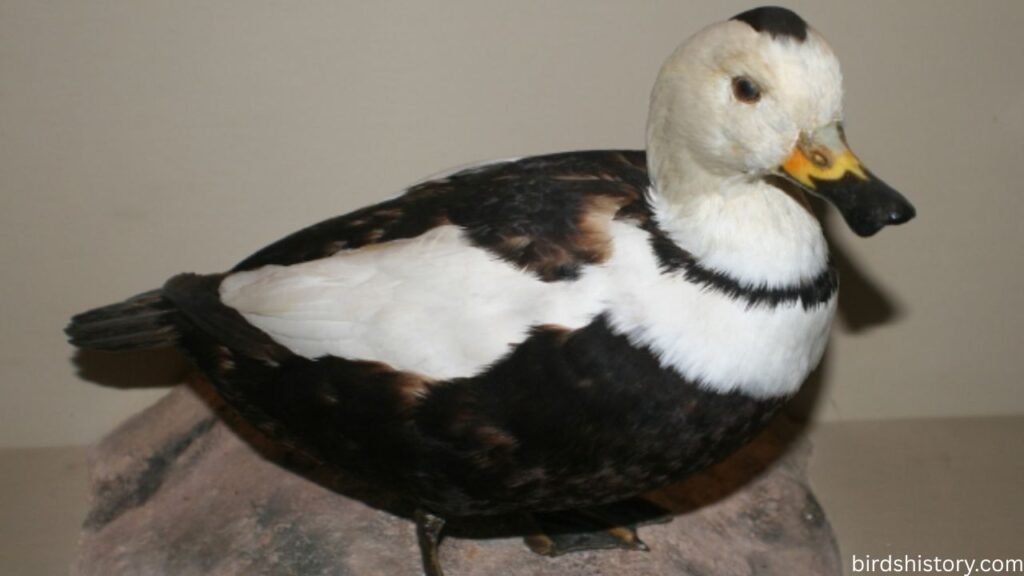
- The bill was distinctive: wide and flattened at the tip, soft, with many lamellae inside (small filtering “ridges”)—adapted for feeding in shallow water, silt, or sand.
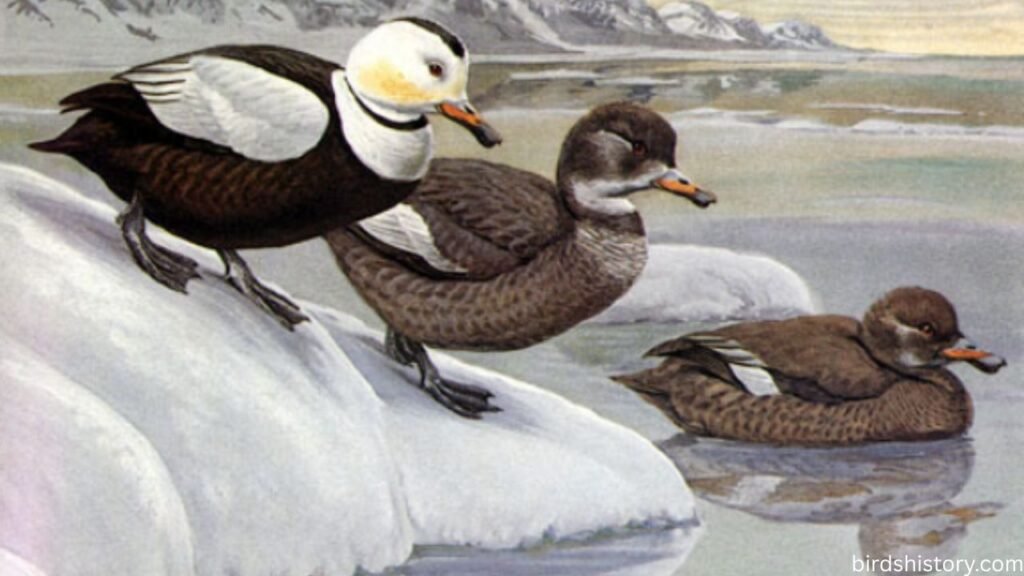
- Male plumage was striking: black and white in an eider-like pattern; wings mostly white except for the primaries.
- Female plumage was more subdued: generally greyish, weakly patterned.
- Body shape: short and somewhat depressed (flattened), feathers dense and soft; short rounded tail; strong, webbed feet set far toward the rear of the body.
Habitat and Range Of Labrador Duck
- Breeding Range: Likely in coastal Labrador and northern Quebec, possibly islands in the Gulf of Saint Lawrence. However, no confirmed nests have been thoroughly documented.
- Winter Range: The Labrador Duck migrated to winter along the northeastern U.S. coast—including New England, Long Island, New Jersey and similar coastal bays, estuaries, harbors. It seems to have preferred sheltered, sandy or silty shallow areas in winter.
- Preferred Environments: Sheltered bays, inlets, harbors, sandbars, shallow coastal waters with lots of molluscs or shellfish in sediment. Not freshwater-lakes or rivers generally.
- Migration Pattern: Seasonal north–south movement: breeding in the summer north (Canada), wintering further south along Atlantic coast.
Labrador Duck Diet and Feeding Habits
- Specialized diet: fed primarily on small molluscs, shellfish, likely crustaceans, snails, mussels.
- Feeding method: used its soft, lamellated bill to probe through sediment or sand, sift out small invertebrates. Because of its bill structure, it probably foraged in shallow, sandy or silty bottoms.
- It might have used tidal zones or shallow coastal flats where shellfish populations flourished.
Behavior and Lifestyle
- Because the species was rare, behavior is not well documented. Much of what is known comes from specimens, a few field observations, and historical records.
- It was likely a social duck to some degree (joining coastal flocks in winter), though records suggest sightings of single birds or very small numbers.
- Flight: as a sea duck, it probably had strong flight but because of its body shape (short and feet set far back) may have had particular take-off or landing challenges (common in sea ducks). Direct evidence is sparse.
- Vocalizations / Calls: virtually unknown. No well-documented recordings or descriptions survive.
Labrador Duck Reproduction and Lifespan
- Breeding Season: Presumed in summer, in northern Canada (coastal Labrador, Gulf of Saint Lawrence). But exact timing, nesting behaviors, nest locations are unconfirmed.
- Nesting Details: No nest has been definitively located. Audubon’s son reported seeing something believed to be a nest in Labrador, but it’s not certain.
- Eggs: No reliable data on number of eggs, their color, or incubation period. These remain unknown.
- Lifespan: Unknown. Because the species is extinct, there’s no data on natural lifespan in wild or captivity. Observers did not record or monitor individuals long enough to estimate.
Must Read About: /huia-histroy/
Predators and Threats
- Natural predators likely included common avian predators (hawks, eagles), mammals that raid nests (foxes, raccoons) especially if eggs were laid in ground or bushes. But specific records are lacking.
- Environmental threats:
- Decline in shellfish / mollusc populations, particularly in wintering grounds, possibly due to overharvesting, pollution, habitat alteration.
- Degradation of coastal habitat: development, human population growth, changes to shorelines, possibly affecting feeding grounds (like estuaries, bays, sandbars).
- Human impacts:
- Egg collecting may have reduced reproduction (though unconfirmed).
- Hunting: interestingly, one finds that the Labrador Duck was not prized for its taste and not heavily hunted for meat. But some hunting and specimen collection did occur.
- Feather trade seems not to have been a major driver (unlike some other species), since its plumage was not especially valued.
Labrador Duck Conservation Status
- IUCN Status: Extinct (EX)
- Last seen: Last confirmed sighting was 1878 in Elmira, New York.
- Museum specimens: There are about 55 specimens preserved in museums worldwide.
- No ongoing conservation efforts possible, of course, since species is gone. But it serves as a case study in extinction, especially for species with specialized diets or habitat needs.
Interesting Facts About Labrador Duck
- The Labrador Duck was the first known endemic North American bird species to go extinct after European settlement / the Columbian Exchange.
- It had many common names: “pied duck,” “skunk duck” (referring to its black and white male plumage), “sand shoal duck” (because of its feeding habits in sandy shallow waters).
- Its extreme rarity was noted even in early European‐settler records; people described it as uncommon and difficult to find.
- Ornithologist Glen Chilton travelled tens of thousands of miles just to study preserved specimens; he compiled detailed work and even offered a reward for finding an unexamined specimen.

Conclusion / Summary
The Labrador Duck is one of those birds that reminds us how fragile ecosystems can be, especially when a species has very specific needs. Its unique bill, the requirement for certain kinds of shallow coastal water with plentiful molluscs, and its habitat along coasts vulnerable to human change all contributed to its vulnerability.
Though much about its life remains unknown—nests, eggs, vocalizations, lifespan—what is clear is that it had a narrow niche. When that niche was disturbed by habitat change, pollution, shellfish decline, and possibly egg collecting, the species was unable to adapt. The story of the Labrador Duck is not just about what was lost, but a warning: specialization can be a strength when conditions are stable; it can be a weakness when change happens fast.
Learning about the Labrador Duck helps us understand broader principles in conservation biology. It teaches us to pay attention to species even before they become common or beloved. It reminds us that rare creatures—though seldom seen—can play roles in their ecosystems, and once gone, they cannot be brought back. Though extinct, the Labrador Duck lives on in museum specimens, in scientific journals, and in our awareness. Protecting what remains, for species still with us, can be the legacy we build.
FAQs About Labrador Duck
- When did the Labrador Duck go extinct?
The last confirmed sighting of a Labrador Duck was in 1878 at Elmira, New York. After that, no verified records exist. - What made the Labrador Duck different from other ducks?
Its bill was unusual: wide, flattened, soft, with many internal lamellae for sifting small shellfish in sediment. Its male plumage was distinctive black and white. Also being rare and likely highly specialized in diet set it apart from more generalist ducks. - Where did the Labrador Duck breed?
It probably bred in coastal Labrador, northern Quebec, and possibly in the islands in the Gulf of St. Lawrence. However, no nest has been definitively located. - What was its diet?
The Labrador Duck fed mainly on small molluscs, crustaceans, snails, and shellfish. Its bill suggests it probed or sifted through shallow mud or sand to find food. - Why wasn’t it hunted heavily?
The meat was not considered good, and the species was already rare. This meant it was not commercially valuable or widely hunted compared to other ducks. - How many specimens remain?
About 55 preserved specimens are held in museums around the world. - Do we know its nesting behavior or eggs?
No. There is no confirmed data on the number of eggs, incubation time, or exact nesting habits. Everything is speculative or drawn from sparse historical reports. - What were the major threats that likely led to its extinction?
The main suspected threats include decline of shellfish (its primary food), habitat alteration along coasts, possibly egg collection, and human disturbance. No single cause is definitively proven. - Is the IUCN status confirmed extinct?
Yes. The Labrador Duck is listed as extinct by the IUCN (EX). - What lessons does its extinction offer for modern conservation?
It highlights how species with specialized diets or habitat needs are especially vulnerable. It shows that even if a species is not hunted much, other pressures (food supply decline, environmental degradation) can drive it to extinction. Early monitoring and protection of specialized habitats are critical.