Hoatzin Bird: The Strange Survivor of the Amazon
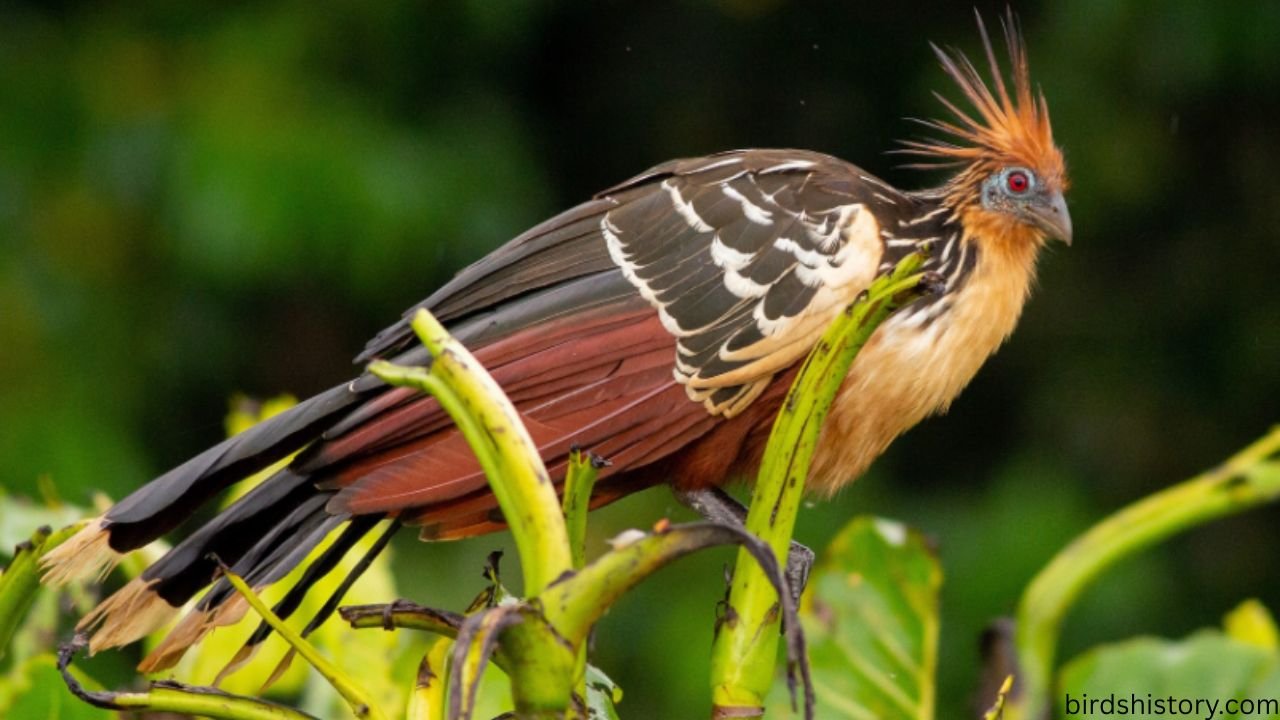
The Hoatzin (Opisthocomus hoazin) is one of the most peculiar and mysterious birds in the world. Found deep in the swamps and river forests of South America, this bird looks like something out of prehistoric times. With its spiky crest, bright blue face, red eyes, and chick claws that resemble those of dinosaurs, the Hoatzin has fascinated scientists and bird lovers alike.
The Hoatzin’s digestive system is what sets it apart from other birds. Unlike any other bird, it ferments leaves in its crop the way cows digest grass. This unusual diet has earned it nicknames like “stinkbird” because of the manure-like odor it gives off.
One surprising fact? Hoatzin chicks are born with claws on their wings that help them climb trees before they can fly—a feature that recalls ancient fossil birds. Let’s dive into the details of this remarkable bird, often described as a “living fossil.”
Taxonomy / Classification
- Common Name: Hoatzin
- Scientific Name: Opisthocomus hoazin
- Family: Opisthocomidae
- Order: Opisthocomiformes
- Class: Aves
The Hoatzin is the only surviving member of both its family and order, making it a true evolutionary oddball. Despite years of study, scientists still debate its closest relatives. Some link it to cuckoos, while others suggest it’s closer to ancient fowl-like birds.
Physical Description
Hoatzin Bird looks like it belongs in the age of dinosaurs. Adults measure about 25–26 inches (65 cm) long and weigh around 1.8–2.2 pounds (800–1,000 g).
Key features include:
- Head and face: A bare, turquoise-blue face with striking red eyes.
- Crest: A spiky, reddish-brown crest of feathers running along the head, giving it a punk-like appearance.
- Plumage: Brown body with white streaks, chestnut-colored wings, and a lighter underside.
- Tail: Long and broad, with rufous edges.
- Beak: Short and stubby compared to most birds.
Also read: /dwarf-cassowary/
Males and females look very similar, with no obvious sexual dimorphism.
Hoatzin hatchlings possess a remarkable physical feature: claws on their wings that they use to climb branches. This feature disappears as they mature but makes them look almost prehistoric in their youth.

Habitat and Range
The Hoatzin is native to South America, especially in countries like:
- Brazil
- Peru
- Colombia
- Venezuela
- Bolivia
- Guyana
- Ecuador
They prefer habitats close to water, such as swamps, riverbanks, floodplains, and mangroves. Hoatzins are rarely found far from rivers, as their leafy diet depends heavily on vegetation growing near wetlands.
Hoatzins remain in their native habitats year-round, as they are non-migratory birds.
Diet and Feeding Habits
The Hoatzin is one of the few strictly folivorous birds—meaning it primarily eats leaves.
- Diet: Mostly young, tender leaves, but also flowers and fruits when available.
- Digestive system: Instead of a gizzard, the Hoatzin has a large crop where bacterial fermentation breaks down tough plant matter—similar to how cows and goats digest grass.
- Feeding behavior: They move slowly through branches, plucking leaves with their short beaks.
Because of this unusual diet and digestion, their meat has a strong, unpleasant odor, making them unappealing to hunters. This is why locals often call them the “stinkbird.”
Behavior and Lifestyle
Hoatzins live in groups of up to 40 birds, as they are highly social creatures. They spend much of their day resting, feeding, and preening in the trees above rivers.
- Social structure: Groups often roost together in communal areas.
- Flight: They are weak fliers, with short, noisy flights due to their large crops. Instead, they hop and climb through branches.
- Calls: Their vocalizations are loud, croaking, and often compared to grunts or hisses.
- Daily rhythm: Most active in the morning and evening, they spend midday resting in the shade.
They rely heavily on group living for protection, with multiple birds watching for predators while others feed.
Reproduction and Lifespan
Breeding usually coincides with the rainy season, when leaves are abundant.
- Nesting: Built over water on tree branches, often in colonies.
- Eggs: Females lay 2–3 pale eggs.
- Incubation: Lasts about 30–32 days, with both parents participating.
- Chicks: Hatch helpless but equipped with claws on their wings. These claws help them cling to branches or even escape from predators by dropping into the water and then climbing back to their nests.
Lifespan: In the wild, Hoatzins are believed to live around 15 years, though exact numbers vary.

Predators and Threats
Natural predators
- Snakes
- Monkeys (which raid nests for eggs and chicks)
- Raptors like hawks and eagles
Environmental threats
- Deforestation and wetland destruction are the biggest dangers.
- Farming and livestock raising are expanding in the Amazon Basin.
Human impact
Luckily, hunting pressure is minimal because the bird’s flesh smells and tastes unpleasant.
Conservation Status
- IUCN Red List: Least Concern
- Population: Stable, with millions of individuals spread across South America.
Though not endangered, the loss of Amazonian wetlands could threaten populations in the future. Conservation efforts mainly focus on protecting their habitats, especially wetlands and river systems.
Interesting Facts About the Hoatzin
- The Hoatzin’s ancient characteristics have led some to refer to it as a “living fossil.”
- Its wing claws in chicks resemble those of Archaeopteryx, an extinct bird-like dinosaur.
- Locals often avoid eating or hunting it because of its bad smell, which ironically helps protect the species.
- It’s the national bird of Guyana.
- Scientists have debated its evolutionary relationships for decades, but no consensus exists—making it one of the most mysterious birds alive today.
Conclusion
The Hoatzin is truly one of nature’s oddities: a leaf-eating, foul-smelling, clawed-winged bird that looks more prehistoric than modern. Found in the lush wetlands of South America, it has survived largely because it tastes bad to predators, including humans.
Even with its unique characteristics, the Hoatzin is crucial for spreading seeds and keeping wetland ecosystems healthy. Learning about this bird reminds us how evolution can create creatures that defy all expectations.
Protecting the Hoatzin’s habitat ensures that future generations can continue to marvel at this “dinosaur bird” of the Amazon.

FAQs
1. What is the Hoatzin’s scientific name?
Opisthocomus hoazin.
2. Why is it called the “stinkbird”?
Because its leaf-fermenting digestion makes it smell like manure.
3. Where does the Hoatzin live?
In swampy, riverine habitats across the Amazon and Orinoco basins in South America.
4. What makes Hoatzin chicks special?
They hatch with claws on their wings that help them climb before they can fly.
5. What do Hoatzins eat?
Their diet consists mainly of leaves, supplemented with some flowers and fruits.
6. Can Hoatzins fly well?
No, they are weak fliers due to their heavy digestive system.
7. Are Hoatzins related to dinosaurs?
They share traits with ancient birds, but their exact evolutionary placement remains debated.
8. Are Hoatzins endangered?
No, they are currently listed as Least Concern by the IUCN.
9. Why don’t people hunt them?
Because their meat smells and tastes unpleasant.
10. What country considers the Hoatzin its national bird?
Guyana.