
The Golden Headed Manakin: Nature’s Tiny Acrobat of the Rainforest
The tropical rainforests of Central and South America are home to some of the most dazzling birds on Earth, and among them, the Golden headed Manakin stands out as a real showstopper. Small in size but bursting with character, this bird is best known for its electric golden head that gleams like sunlight filtering through the forest canopy.
What makes it truly fascinating is not just its striking looks, but also its extraordinary mating rituals. Male manakins are nature’s entertainers, performing lightning-fast courtship dances that leave birdwatchers both amused and amazed. They hop, flip, and glide in acrobatic displays that seem almost choreographed—earning them nicknames like “the dancers of the rainforest.”
Found across the humid forests of Central America, Trinidad, and the Amazon Basin, the Golden-headed Manakin is proof that sometimes the smallest creatures pack the biggest surprises. A fun fact: their mating dance happens so quickly that scientists often study it in slow motion to catch every detail.
Golden Headed Manakin Taxonomy / Classification
To better understand this bird, let’s place it in its scientific context:
- Common Name: Golden headed Manakin
- Scientific Name: Ceratopipra erythrocephala
- Family: Pipridae (the manakin family)
- Order: Passeriformes (perching birds)
- Class: Aves
Also read: /crimson-topaz-hummingbird/
The Pipridae family contains more than 50 species of manakins, all of which are famous for their elaborate courtship displays. The Golden-headed Manakin is one of the most widespread and recognizable members of the group.
Golden Headed Manakin Physical Description
At first glance, the Golden headed Manakin might seem like a small, ordinary songbird. But a closer look reveals just how special it is.
- Size: About 9–10 cm (3.5–4 inches) long and weighing around 12–15 grams.
- Male Plumage: Jet-black body with a brilliant metallic golden-yellow head that shines like a polished crown. Their eyes are pale white, creating a sharp contrast against their dark feathers.
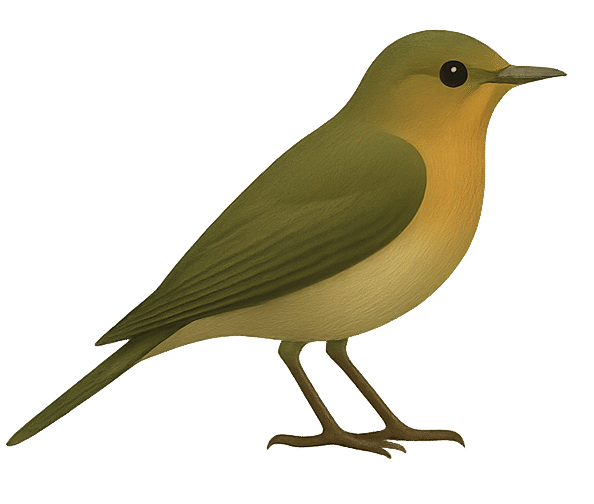
- Female Plumage: Olive-green overall, blending well with the forest. Females lack the bright golden head, which helps them stay camouflaged while nesting.
- Beak: Short and black, suited for eating fruit.
- Tail: Short and square, aiding quick bursts of flight during displays.
The striking sexual dimorphism is a textbook example of how evolution favors males with flashy colors for courtship, while females stay camouflaged for survival.

Habitat and Range
The Golden headed Manakin thrives in the lush, humid environments of the tropics.
- Range: From southern Central America (Costa Rica, Panama) to northern South America (Colombia, Venezuela, Ecuador, Peru, Bolivia, Brazil, and Trinidad).
- This species prefers to live in lowland and foothill tropical rainforests, particularly in areas with forest edges, clearings, and new secondary growth.
- Altitude: Typically found up to 1,200 meters (3,900 feet) above sea level.
- Migration: These birds are non-migratory, remaining year-round within their territories.
Because they prefer dense forests with plenty of fruiting trees, deforestation can dramatically impact their populations.
Diet and Feeding Habits of Golden Headed Manakin
Golden-headed Manakins mainly eat fruit, but they also consume insects to round out their diet.
- Fruits: They eat small berries and fruits, swallowing them whole and later dispersing seeds throughout the forest. This makes them important contributors to rainforest regeneration.
- Insects: Occasionally catch small insects mid-air or pluck them from leaves for protein.
- Feeding Behavior: Forages in the mid-levels of the forest, usually in quick, darting movements.
Their role as seed dispersers is essential for the survival of many tropical plant species.
Behavior and Lifestyle
Golden-headed Manakins may be small, but their personalities are larger than life.
- Social Behavior: Males gather at special “courts” called leks, where they perform elaborate dances to attract females.
- Flight: Fast, darting, and agile, perfect for sudden bursts during displays.
- Vocalizations: High-pitched buzzing and snapping sounds. Interestingly, some of their courtship sounds are made with their wings, not their voices.
- Mating Rituals: Their courtship is legendary—males hop between perches, do backward somersaults, and even slide across branches in a move often described as “the moonwalk of the jungle.”
Watching a group of males perform is like seeing a natural dance-off, where the most skilled and energetic male wins the female’s attention.
Reproduction and Lifespan
The reproductive behavior of the Golden-headed Manakin is one of its most studied traits.
- Breeding Season: Varies by location, often tied to rainy seasons when fruit is plentiful.
- Nesting: Females build small, shallow cup-shaped nests in low shrubs or saplings, usually 1–2 meters above the ground.
- Eggs: Typically lay 1–2 eggs, pale brown or creamy with speckles.
- Incubation: Around 14–16 days, carried out entirely by the female.
- Chick Care: Females alone care for the chicks; males provide no parental support, focusing instead on courtship.
- Lifespan: Estimated 7–10 years in the wild.
This stark division of roles—males focusing on display, females handling parenting—highlights how sexual selection shapes bird behavior.

Predators and Threats
Golden-headed Manakins are small and easy to spot, making them vulnerable to numerous natural predators.
- Predators: Snakes, monkeys, and birds of prey like hawks often target eggs, chicks, or adults.
- Environmental Threats: Habitat loss due to logging, agriculture, and urban expansion.
- Human Impact: While not heavily hunted, they suffer indirectly from deforestation and habitat fragmentation.
Despite their dazzling displays, their reliance on healthy rainforests makes them vulnerable.
Golden Headed Manakin Conservation Status
The IUCN Red List has categorized the Golden-headed Manakin as a species of “Least Concern.”
- Population: Still widespread across Central and South America.
- Conservation Concerns: Local declines where deforestation is severe.
- Conservation Efforts: Protected in many national parks and reserves, especially in the Amazon Basin.
Maintaining large tracts of rainforest is the key to ensuring their continued survival.
Interesting Facts About Golden Headed Manakin
- Like athletes preparing for a major competition, male Golden-headed Manakins practice their courtship displays together in groups before they perform for the females.
- Their “moonwalk” display, where they slide backward along a branch, is one of the fastest recorded bird courtship moves.
- They can complete up to six acrobatic jumps per second during display.
- Unlike many tropical birds, they rely more on movement than song to impress females.
- They’re so fast that many displays are invisible to the human eye unless slowed down by high-speed cameras.
- Their bright head feathers are structurally colored, reflecting light to produce their golden sheen.
- Females select their partners almost exclusively based on how well the males perform their courtship displays.
- They play a crucial ecological role by dispersing seeds of many rainforest plants.
- Males often spend hours a day rehearsing displays, even when no females are present.
- Despite being one of the most colorful birds, they are surprisingly quiet and hard to spot outside courtship season.
Conclusion
The Golden-headed Manakin may be tiny, but it embodies the wonder of the rainforest. With its vibrant golden head and incredibly fast, acrobatic dances, this bird captivates both scientists and birdwatchers. Beyond its beauty, it plays an essential role in maintaining tropical ecosystems by dispersing seeds.
Protecting this species means protecting the rainforests that sustain it—and in turn, safeguarding one of the most diverse and vital ecosystems on our planet. If you ever find yourself deep in the jungles of South America, keep an eye on the branches just above the understory. You might just glimpse nature’s most dazzling little dancer putting on a show.

FAQs About Golden Headed Manakin
1. What is the Golden headed Manakin’s scientific name?
Ceratopipra erythrocephala.
2. Where is the Golden headed Manakin found?
In tropical forests of Central America, northern South America, and Trinidad.
3. Why is it called a “manakin”?
The name comes from Middle Dutch “mannekijn,” meaning “little man,” referring to their small size.
4. What do Golden headed Manakins eat?
Mostly fruit, with occasional insects.
5. How do males attract females?
Through elaborate dance displays at leks, involving flips, hops, and sliding movements.
6. Do males help raise chicks?
No, only females incubate eggs and care for young.
7. Are Golden-headed Manakins endangered?
Not currently; they are listed as Least Concern.
8. How long do they live?
Around 7–10 years in the wild.
9. Can they be seen in groups?
Males gather in groups for display, while females are more solitary outside breeding.
10. Why are they important to the ecosystem?
They disperse seeds, helping rainforest plants regenerate and spread.