
Pink-headed Duck: The Lost Beauty of Asia’s Wetlands
The Pink-headed Duck is one of those birds that seems lifted from a painting. Its striking rosy head and neck, contrasting with a rich dark body, make it an unforgettable sight. It’s deeply interesting because no one has seen it reliably in the wild for over 70 years, yet locals still whisper sightings, and some remote wetlands might still hide a remnant population. It lived in India, Bangladesh, and Myanmar. One fun fact: its eggs are almost perfectly spherical — much more so than those of most ducks. That small detail gives clues about its behavior and nesting habits.
Pink-headed Duck Taxonomy / Classification
Here’s how the Pink-headed Duck fits in the sweep of bird classification:
- Common Name: Pink-headed Duck
- Scientific Name: Rhodonessa caryophyllacea
- Family: Anatidae (the duck, goose, and swan family)
- Order: Anseriformes
- Class: Aves
Also read: /california-condor/
Pink-headed Duck Physical Description
Here’s what this duck looked like, based on historic specimens and descriptions:
- Size and shape: The Pink-headed Duck was a medium-sized duck, with a body length around 41-43 cm.
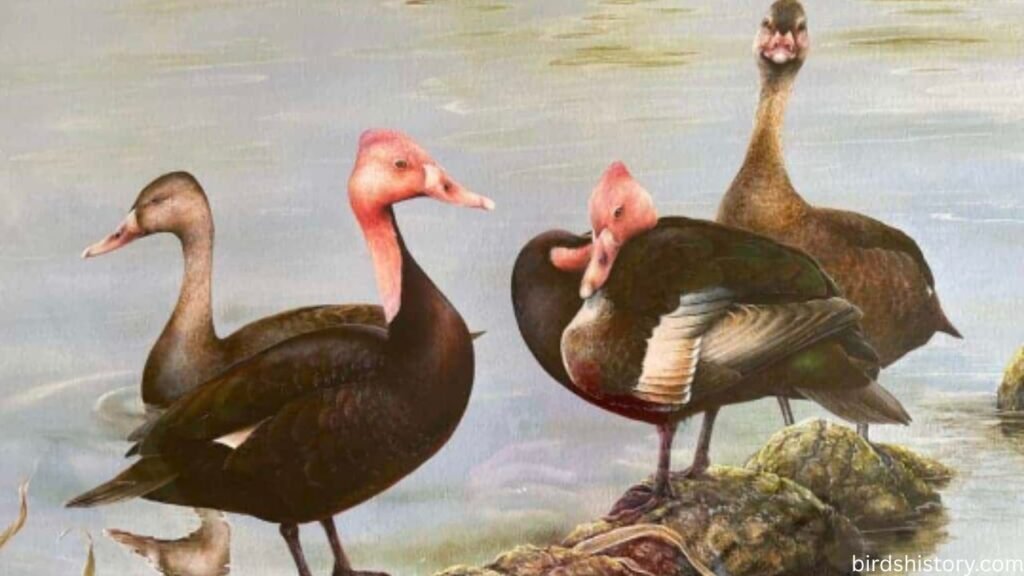
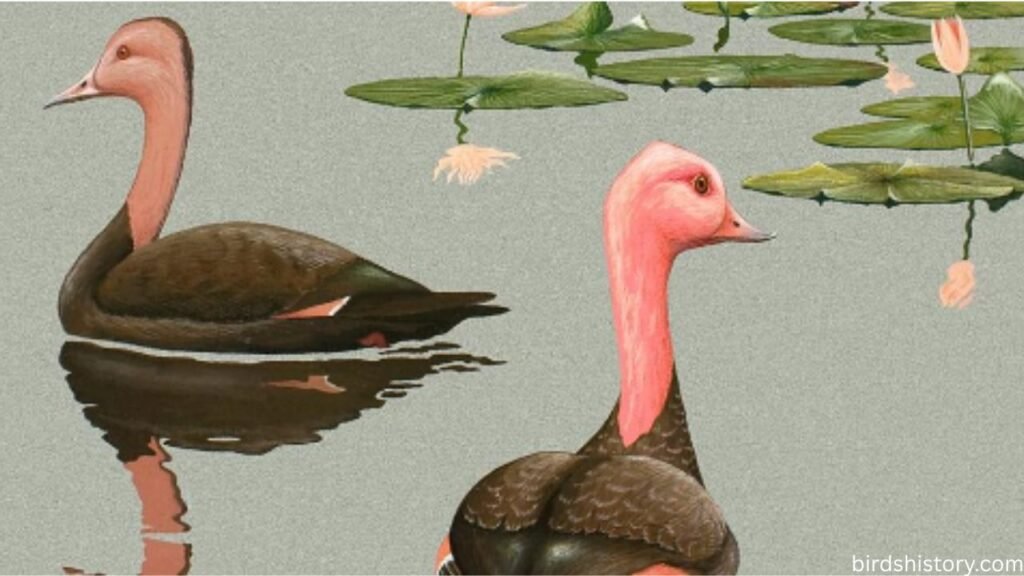
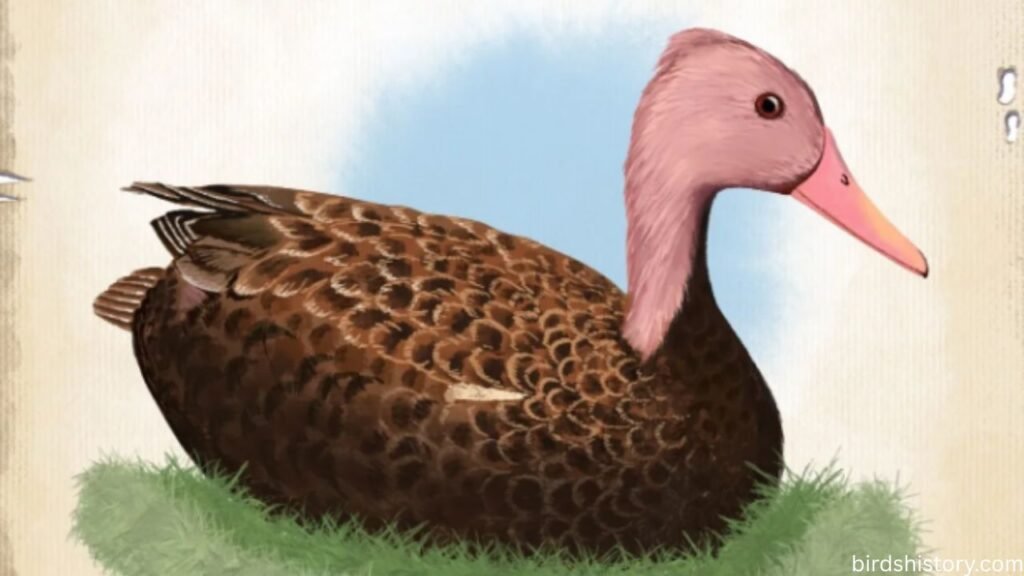
- Color and plumage: The male’s head, bill, and neck were pale rosy pink. The rest of its body was glossy dark brown, paler beneath. The female was less vivid—her head and neck were a much paler pink and her bill lighter too. Juveniles lacked much pink; young birds’ heads were nearly whitish.
- Wings and markings: The wings had a white edge along the leading edge. The speculum (that patch on the wings) had reddish tones and a white band. In flight, contrast was modest unless viewed under good light.
- Bill, neck, and other features: Long bill, slender neck, peaked head with a slight tuft or crest in some descriptions. Legs and feet were typical of ducks (web-footed).
- Unique traits: The spherical nature of its eggs stands out. Also, its coloration is unusual among ducks, especially the pink head and neck, which is rare. Another unusual feature: a modified structure of the trachea (inflated bony structure or bulla) in males, with small windows (“fenestrae”), that may have had a role in vocalizations.
Habitat and Range
Where this duck lived, and possibly still lives, gives us clues to both its mystery and vulnerability.
- Geographic range: Historically found in India (especially northern and northeastern India), Bangladesh, and Myanmar. There are some unconfirmed or anecdotal reports from adjacent regions.
- Preferred habitat: The duck favored secluded, overgrown freshwater wetlands — marshes, ponds, shallow still waters surrounded by tall grass or dense vegetation. Areas with seasonal flooding or floodplain wetlands were ideal.
- Behavior related to habitat: It may have been sedentary or only making local seasonal movements. Doesn’t seem to have migrated long distances. In the colder months it might have used rivers or lagoons.
Pink-headed Duck Diet and Feeding Habits
What did the Pink-headed Duck eat, and how did it get its food?
- Diet: Based on stomach contents of dead specimens and historic observations, it ate aquatic plants (waterweeds), molluscs, possibly small shells and maybe some invertebrates.
- Feeding style: It was a dabbling duck — meaning it fed at or near the surface, tipping its tail up to reach water or submerged plants. There is some evidence it could dive, though this is less certain. Much feeding likely happened in shallow water, or at edges of water bodies with vegetation.
- Behavior while feeding: Solitary or in pairs often, sometimes small groups. Because of its shy nature and dense vegetative habitat, feeding might have been stealthy. Possibly more active at dawn or dusk, though there is limited data.
Pink-headed Duck Behavior and Lifestyle
Here’s what is known (and some educated guesses) about how this duck lived day to day.
- Social or solitary: It was often seen alone or in pairs. Occasionally small groups (up to about 10), and in some seasons possibly flocks of more individuals. But never large congregations reported reliably.
- Activity pattern: Very secretive. Possibly crepuscular (active during dawn/dusk) or even nocturnal behavior in some habitats, which can make sightings rare and detection difficult.
- Flight: Able to fly. There are historic descriptions of birds in flight. However, being more comfortable in water and heavily vegetated wetlands, they likely preferred not to fly much unless disturbed.
- Nesting / breeding behavior: Nesting among tall grasses or reeds close to water. Nests made of dry grasses and soft lining like feathers. Both male and female involved in nest care in some reports. Eggs nearly spherical, creamy white or pale. Clutches of 6-9 eggs reported in some accounts.
Pink-headed Duck Reproduction and Lifespan
What is known about the duck’s breeding cycle and life duration.
- Breeding season: Reports suggest breeding begins around April in its range. Conditions best when water levels and vegetation are optimal (after rains).
- Nesting details: Nests were placed in concealed spots among tall grass or reeds near water. Built from grasses, lined with feathers. The shape was round/rounded. Eggs are nearly spherical. Clutch size ranged between six to nine in some reports.
- Eggs: Creamy white or pale yellowish. Very spherical. Size in some records: around 1.7-1.8 inches long by about 1.6-1.7 inches wide.
- Lifespan: Not well documented. In captivity, a few individuals lived up to perhaps 10-12 years. But because there were very few in captivity, records are poor. Wild lifespan is unknown — likely less due to threats.
Predators and Threats
What endangered the Pink-headed Duck, both naturally and through human actions.
- Natural predators: Eggs and chicks vulnerable to predators typical in wetlands: snakes, monitor lizards, possibly birds of prey and terrestrial mammals. Adult ducks less vulnerable in water but at risk on land or in flight. Vegetation cover helps avoid predation.
- Environmental threats:
- Habitat loss: Conversion of marshes, swamps, floodplain wetlands for agriculture; drainage of wetlands.
- Vegetation change: Invasion by water hyacinth and other aquatic weeds may change the wetland structure and reduce suitable habitat.
- Human impact:
- Hunting: The Pink-headed Duck was hunted historically for sport, feathers, and possibly food. Collecting specimens was popular among private bird collectors and zoos.
- Capture for trade: Along with hunting, some specimens were captured live for aviculture and museums. Rewards were even offered to procure live specimens. This increased pressure on the remaining populations.
- Disturbance: Wetlands were sometimes disturbed by people, livestock, or changes in water regimes. Seasonal flooding management, dams, or irrigation projects may have reduced available habitat.
Pink-headed Duck Conservation Status
Is this bird extinct? Lost? Or possibly hanging on?
- Current status: Critically Endangered (Possibly Extinct) according to BirdLife International. It has not been conclusively seen in the wild since 1949 in India. A few unconfirmed reports have arisen since then, especially from remote parts of Myanmar.
- IUCN listing: Rhodonessa caryophyllacea is listed as Critically Endangered, possibly extinct.
- Conservation efforts & searches:
- Several “Search for Lost Species” expeditions have looked for it, especially in Myanmar’s remote wetlands (e.g. Kachin State). So far, no confirmed photograph or specimen has been documented.
- Interviews with local people sometimes yield credible reports. However, many of these are difficult to verify and may involve misidentification.
- Legal protections were introduced (for example in India) but generally long after the species had become rare. These measures came too late to prevent its decline.
Interesting Facts About Pink-headed Duck
These are small details that make the Pink-headed Duck especially intriguing.
- Its eggs are nearly perfectly spherical — unusual among ducks. That shape may help in concealed nests or in humid, wetland conditions.
- Males had a special tracheal bulla (inflated structure in the windpipe) with small windows (fenestrae). That might have played a part in sound resonance or vocalization.
- Even when it was known, it was always considered rare. Even in the late 19th and early 20th centuries, few specimens were taken or encountered.
- Although long declared lost, search efforts continue. For many birdwatchers and conservationists, it represents a glimmer of hope: the possibility that a species assumed extinct might still survive in hidden corners of the world.
Conclusion / Summary
The Pink-headed Duck is a reminder of how fragile some species are when their lives depend on a shrinking, specialized habitat and when human pressures accumulate. Its unique pink head and neck, almost spherical eggs, its preference for dense, overgrown wetlands — all of these made it special. But those same traits made it vulnerable: it needed very specific environments, it was shy and hard to find, and when humans hunted it, collected it, and drained its marshes, the Pink-headed Duck was not resilient enough to recover.
Learning about this bird is more than just cataloging a lost species. It teaches us to pay attention early, to act while there’s still habitat left, and to conserve even the rarest. It reminds us that sometimes a species vanishes quietly, without fanfare, but with the loss still rippling through ecosystems. If a remnant population still exists, it deserves protection. If not, its story is a lesson for future conservation.
FAQs About Pink-headed Duck
- Q: Is the Pink-headed Duck extinct?
A: It is officially listed as Critically Endangered and possibly extinct. No confirmed wild sightings since 1949. - Q: Why is Pink-headed Duck called “Pink-headed”?
A: Because the male has a rosy pink head, bill, and neck. The female is paler but still shows some pink. Juveniles lack the strong pink coloration. - Q: Where did Pink-headed Duck live?
A: In freshwater wetlands, swamps, marshes, floodplains, ponds with tall grass or dense vegetation in India, Bangladesh, and Myanmar. - Q: What did Pink-headed Duck eat?
A: Aquatic plants, waterweeds; molluscs; small shells; possibly invertebrates in shallow water. It fed by dabbling and upending; evidence for diving is limited. - Q: When was the last confirmed sighting?
A: The last confirmed wild sightings are from around 1949. After that, reports have been unverified. - Q: Did people try to protect Pink-headed Duck?
A: Yes, but much of the legal protection came after the species had already become very rare. Some private collectors and zoos kept specimens. Recent surveys and conservation interest exist. - Q: What made Pink-headed Duck hard to spot?
A: Its shy nature; preference for dense vegetation and secluded waters; possibly nocturnal or crepuscular habits; very few individuals if any left. - Q: How many eggs did Pink-headed Duck lay and what were they like?
A: They laid 6 to 9 eggs per clutch in some reports. The eggs were creamy white or pale, and unusually spherical. - Q: Could Pink-headed Duck still exist somewhere?
A: Some hope remains, particularly in remote or inaccessible wetlands of Myanmar. But despite survey efforts, no confirmed evidence has been found recently. If it survives, population is likely extremely small. - Q: What lessons does Pink-headed Duck story teach us?
A: To protect habitats early; to value rare species even when they are not in the popular spotlight; to support scientific surveys and local knowledge; and to act before it becomes too late.