
Greylag Goose: A Complete History of Nature’s Iconic Bird
The Greylag Goose (Anser anser) is one of the most recognizable wild geese in the world. Known for its loud honking calls and large flocks in migration season, this bird is both fascinating and historically significant. You’ll often see them across wetlands, lakes, and farmlands in Europe and Asia.
What makes the Greylag Goose especially interesting is that it’s the ancestor of most domestic geese kept today. So, when you picture farmyard geese, you’re essentially looking at a descendant of this wild bird. Add to that its cooperative family life and long journeys across continents, and you have a bird worth exploring in detail.
Greylag Goose Taxonomy / Classification
Like every species, the Greylag Goose fits into the tree of life with its own scientific classification:
- Common Name: Greylag Goose
- Scientific Name: Anser anser
- Family: Anatidae (ducks, geese, and swans)
- Order: Anseriformes
- Class: Aves
Also read: /the-mallard/
This classification places it among waterfowl, a group adapted to both flying and swimming, with strong wings and webbed feet.
Greylag Goose Physical Description
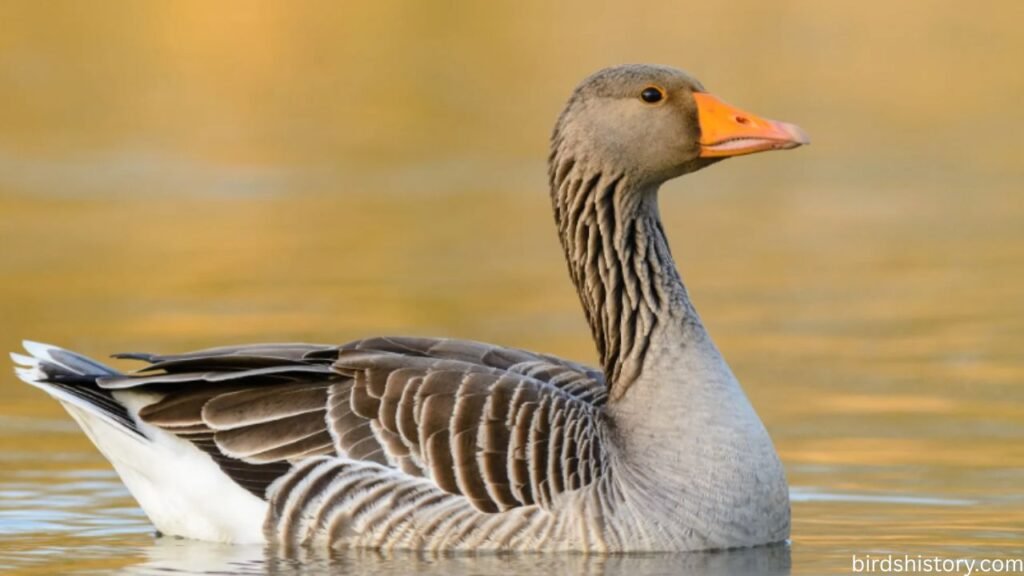
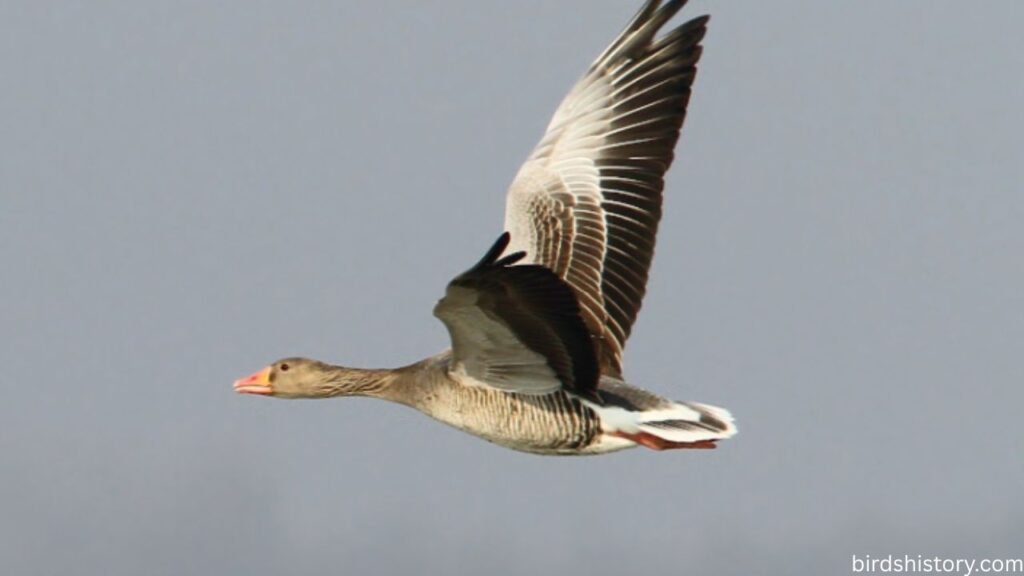
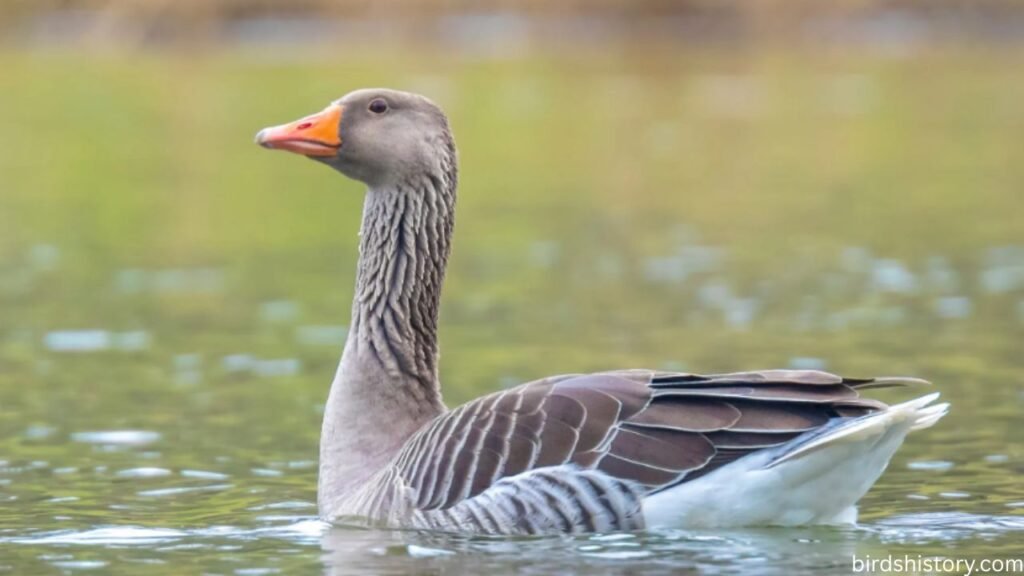
The Greylag Goose has a sturdy, heavy-bodied frame that makes it easy to identify.
- Size: Adults measure 75–90 cm (30–35 inches) long with a wingspan of 150–180 cm (59–71 inches).
- Weight: They typically weigh between 2.5–4 kg (5.5–8.8 lbs).
- Plumage: Their feathers are mainly grey-brown with paler underparts. The back and wings are marked with darker brown stripes.
- Beak: Orange or pink, fairly thick, ideal for grazing.
- Legs and Feet: Pinkish in color and webbed for swimming.
- Sex Differences: Males and females look very similar, though males are slightly larger.
- Distinct Traits: A long, thick neck and a white line running around the base of the bill help distinguish them from other geese.
Their broad wings and powerful flight muscles allow them to travel hundreds of kilometers during migration.
Habitat and Range of Greylag Goose
The Greylag Goose is widely distributed and adapts to different landscapes.
- Regions: Found across Europe, Asia, and introduced in North America.
- Breeding Grounds: Northern and central Europe, parts of Asia.
- Wintering Areas: Southern Europe, North Africa, the Middle East, and South Asia.
- Habitats: Lakes, marshes, wetlands, and agricultural fields. They prefer areas near water for safety and feeding.
- Migration: A strong migratory bird, flying in large V-shaped flocks. Populations in milder climates may remain year-round.
Their adaptability has made them one of the most widespread wild geese.
Diet and Feeding Habits
The Greylag Goose is primarily a herbivore.
- Main Diet: Grasses, roots, shoots, grains, and seeds.
- Feeding Behavior: They graze on land like sheep, pulling up grass with their beaks. In wetlands, they may dabble for aquatic plants.
- Agricultural Link: Often found feeding on farm crops like wheat, barley, and rice. This sometimes causes conflict with farmers.
- Unique Trait: They have strong digestive systems that allow them to extract energy from tough grasses.
Their foraging style often benefits ecosystems by maintaining open grasslands and preventing overgrowth.
Behavior and Lifestyle
Greylag Geese are social, vocal, and highly intelligent birds.
- Social Behavior: They live in flocks, especially during migration and winter. Family units often stay together within the group.
- Flight Style: They fly in V-formations to conserve energy, taking turns leading the flock.
- Calls: Loud, honking calls are used to communicate in flight or when alarmed.
- Mating Rituals: They are monogamous, usually forming lifelong pairs. During courtship, males perform head bobbing and loud calls.
- Nesting: Both parents protect and care for their young, showing strong family bonds.
This cooperative lifestyle helps them thrive in both wild and human-influenced environments.
Reproduction and Lifespan of Greylag Goose
The Greylag Goose follows a structured breeding cycle.
- Breeding Season: Late spring to early summer, depending on the region.
- Nesting: Nests are built on the ground, often in tall grass or reeds near water.
- Eggs: Females lay 4–6 large white eggs.
- The female primarily incubates the eggs for approximately 27-28 days.
- Goslings: Down-covered chicks can walk and swim soon after hatching. Both parents guard them closely.
- Lifespan: Around 8–12 years in the wild, though in captivity they can live up to 20–25 years.
Their high parental care ensures good survival rates for the young.
Predators and Threats
Even though they are strong and cautious, Greylag Geese face several dangers.
- Natural Predators: Foxes, wolves, eagles, and large gulls prey on eggs and goslings.
- Human Threats: Hunting, egg collection, and habitat destruction.
- Environmental Issues: Wetland drainage, pollution, and climate change disrupt their ecosystems.
- Agricultural Conflicts: Labeled as crop pests in some areas, leading to culling.
Despite these threats, their adaptability has helped them maintain strong populations.
Greylag Goose Conservation Status
The International Union for Conservation of Nature (IUCN) considers the Greylag Goose to be a species of Least Concern.
- Population Trend: Stable and even increasing in some regions due to conservation laws.
- Legal Protection: In many countries, hunting is regulated or restricted.
- Conservation Efforts: Protected wetlands, awareness campaigns, and eco-tourism support their survival.
They are one of the conservation success stories among waterfowl, benefiting from better environmental policies.
Interesting Facts About Greylag Goose
Here are some engaging details about the Greylag Goose:
- Greylag geese are the ancestors of today’s domesticated geese, with their domestication occurring thousands of years ago.
- Ancient Romans and Greeks associated them with loyalty and protection.
- The term “greylag” refers to their habit of lagging behind in migration compared to other geese.
- They can fly up to 70 km/h in migration.
- Goslings often imprint on humans if raised by hand, famously studied by zoologist Konrad Lorenz.
- They have excellent memories for routes and landscapes.
- Unlike some other geese, they often adapt well to farmland and urban lakes.
- Their V-formation flying reduces energy use by up to 20–30%.
- In folklore, they are symbols of fidelity and family unity.
- They are highly vocal and use different calls for alarm, comfort, and coordination.
Conclusion
The Greylag Goose is far more than a familiar sight in wetlands or farmlands. It’s a bird with a deep cultural history, ecological importance, and a fascinating lifestyle. From being the ancestor of domestic geese to its loyal family bonds and spectacular migrations, the Greylag Goose is a true icon of nature.
Learning about birds like the Greylag Goose helps us understand the delicate balance of ecosystems and the role humans play in protecting these species. Next time you hear their honking overhead in autumn skies, you’ll know you’re watching one of the most remarkable stories in bird evolution.
FAQs About Greylag Goose
1. What is the scientific name of the Greylag Goose?
Anser anser.
2. Where are Greylag Geese commonly found?
Across Europe, Asia, and introduced populations in North America.
3. Are Greylag Geese migratory?
Yes, many populations migrate south during winter, though some remain resident in mild climates.
4. What do Greylag Geese eat?
Mainly grasses, seeds, roots, and crops.
5. How long do they live?
In the wild, they typically live for 8-12 years, but their lifespan can extend to 20-25 years in captivity.
6. Do Greylag Geese mate for life?
Yes, they are usually monogamous with lifelong pair bonds.
7. Are they endangered?
No, their conservation status is Least Concern with stable populations.
8. Why are they called “Greylag”?
Because they migrate later (“lag”) than other goose species.
9. What predators do they face?
Foxes, eagles, wolves, and large gulls.
10. Are they ancestors of domestic geese?
Yes, most domestic geese worldwide descend from the Greylag Goose.