
Plum Throated Cotinga Is Jewel of the Amazon Rainforest
If you’ve ever seen a photo of the Plum Throated Cotinga, you’ll know why bird lovers describe it as one of the most stunning gems of the Amazon. This brightly colored bird, with its striking purple throat and shimmering blue body, looks almost unreal. Found in the lush tropical forests of South America, the Plum Throated Cotinga (Cotinga maynana) is a bird that turns heads wherever it appears.
What makes it especially fascinating is not only its dazzling appearance but also its quiet lifestyle. Unlike many songbirds, this cotinga doesn’t sing complex songs—it prefers a more discreet approach to communication. It’s a bird of beauty and mystery, living deep in the rainforests that play a crucial role in our planet’s health.
One fun fact? This bird is so colorful that early explorers thought it was a painted specimen rather than a naturally vibrant species. That alone shows how remarkable the Plum Throated Cotinga truly is.
Plum Throated Cotinga Taxonomy / Classification
The Plum Throated Cotinga belongs to the family of tropical birds known for their bright plumage and fruit-loving habits. Here’s its basic scientific breakdown:
- Common Name: Plum Throated Cotinga
- Scientific Name: Cotinga maynana
- Family: Cotingidae
- Order: Passeriformes
- Class: Aves
Also read: ]/hoatzin-bird/
The Cotingidae family includes many birds famous for their flamboyant feathers and unique courtship displays. While some of its relatives are loud and active, the Plum Throated Cotinga stands out for its more peaceful, almost serene nature.
Plum Throated Cotinga Physical Description
The Plum Throated Cotinga is small to medium-sized, usually around 18–20 cm (7–8 inches) in length. Its beauty lies in the contrast of its colors:
- Male Appearance:
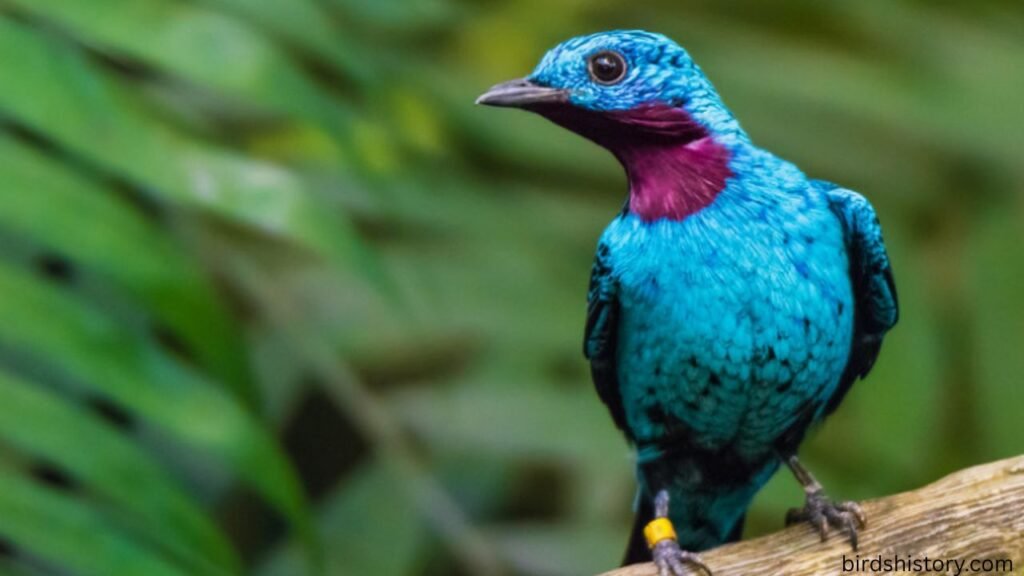
Males are the showstoppers. Their throat and chest display a deep, rich purple that glimmers in the sunlight. The rest of their plumage is a brilliant turquoise-blue, with wings slightly darker in shade. Their beak is small and fairly inconspicuous, designed more for eating fruit than catching prey. - Female Appearance:
Females are less dramatic but still elegant. They are generally brownish-gray with subtle patterning, which helps them blend into the forest canopy. This camouflage plays a vital role during nesting season. - Unique Traits:
- Bright plumage in males for courtship displays.
- Relatively small bill, suited for a fruit-based diet.
- These birds have a small body, short tails, and rounded wings, which help them navigate through thick rainforests.
It’s easy to see why birdwatchers and photographers travel far just for a glimpse of the male Plum Throated Cotinga—it looks like a flying jewel.
Habitat and Range Of Plum Throated Cotinga
This species is native to the Amazon Basin and surrounding regions of South America. Its distribution includes:
- Countries: Brazil, Peru, Ecuador, Colombia, and Bolivia.
- Preferred Habitat: Lowland tropical forests, especially near rivers and forest edges where fruiting trees are abundant.
- Elevation Range: Typically found from sea level up to about 1,000 meters (3,300 feet).
Unlike migratory birds, Plum Throated Cotingas are mostly resident. They stay in the same general areas year-round, depending on fruit availability. Their survival is closely tied to the health of the rainforest ecosystem.
Diet and Feeding Habits
The Plum-throated Cotinga mainly eats fruit, classifying it as a frugivore. However, it occasionally supplements its diet with insects.
- Favorite Foods: Figs, berries, and small rainforest fruits.
- Feeding Behavior:
- Usually perches quietly while scanning for ripe fruit.
- Feeds alone or in loose groups, often alongside other fruit-eating birds.
- Plays an important ecological role as a seed disperser, helping regenerate the rainforest.
Their method of eating is simple but effective: swallow fruit whole, then later expel or pass the seeds, allowing new plants to grow across the forest.
Behavior and Lifestyle
The Plum-throated Cotinga is neither loud nor confrontational. In fact, it’s known for being rather shy.
- Social Behavior:
Generally solitary or found in small groups. Unlike parrots or toucans, they don’t move in large flocks. - Flight Style:
Their flight is short and somewhat direct, with fast wingbeats to move between trees. They spend more time perched than flying. - Vocalizations:
Unlike many colorful birds, they are relatively quiet. Their calls are soft and simple, sometimes resembling low whistles or chirps. - Courtship Displays:
The male’s plumage does much of the talking. During breeding, males often perch in visible spots to show off their brilliant purple throats to attract females.

Reproduction and Lifespan
Breeding behaviors of the Plum Throated Cotinga are still not fully studied, but scientists have gathered enough observations to understand the basics.
- Breeding Season: Generally during the rainy season when food is abundant.
- Nesting: Females build small cup-shaped nests in trees, often hidden by leaves for protection.
- Eggs: Usually 1–2 eggs per clutch. Eggs are pale in color, often whitish or slightly speckled.
- Incubation: The female does most of the incubation, lasting around 2–3 weeks.
- Parental Care: The mother cares for the chicks until they fledge. Males primarily focus on courtship and territory during this period.
Lifespan: In the wild, their average lifespan is estimated at around 7–10 years, although this can vary depending on threats and predation.
Predators and Threats
Like many rainforest birds, the Plum Throated Cotinga faces natural and human-caused dangers.
- Natural Predators:
Snakes, raptors, and tree-dwelling mammals may prey on eggs, chicks, or even adult birds. - Environmental Threats:
- Deforestation: Logging, agriculture, and mining reduce the forest cover they depend on.
- Climate Change: Alters fruiting cycles and habitats.
- Human Encroachment: Expansion of towns and roads into rainforest areas.
These pressures threaten not only this species but also the rainforest ecosystem as a whole.
Plum Throated Cotinga Conservation Status
The International Union for Conservation of Nature (IUCN) currently classifies the Plum-throated Cotinga as a species of “Least Concern.” This means it is not immediately endangered. However, its population is declining slowly due to habitat destruction.
- Key Points:
- Still widespread in the Amazon Basin.
- Not yet at critical risk, but vulnerable to ongoing deforestation.
- Conservation depends on preserving large tracts of rainforest.
Local and international conservation groups emphasize protecting Amazon habitats, since saving the rainforest benefits countless species—including this vibrant bird.
Interesting Facts About Plum Throated Cotinga
Here are some fun and engaging tidbits about the Plum Throated Cotinga:
- It’s one of the most colorful members of the cotinga family, rivaled only by its close cousin, the Spangled Cotinga.
- Despite its dazzling plumage, it’s surprisingly quiet compared to many tropical birds.
- Early explorers and naturalists once thought its colors were artificially enhanced.
- By dispersing seeds, it plays a hidden but vital role in keeping the Amazon alive.
- Photographers often call it a “bucket-list bird” due to its rarity and photogenic appeal.
Conclusion
The Plum Throated Cotinga is more than just a pretty face. It plays a silent yet crucial role in the Amazon rainforest, serving as both a beautiful highlight of the canopy and a key contributor to spreading seeds. Its deep purple throat and bright blue body make it unforgettable, while its calm nature adds an air of mystery.
Learning about birds like the Plum Throated Cotinga reminds us why the rainforest matters. Every species, regardless of its size or how quiet it is, has a part to play in the ecosystem. Protecting these birds means protecting the Amazon—and, ultimately, our planet’s health.

FAQs About Plum Throated Cotinga
1. What is the scientific name of the Plum Throated Cotinga?
Its scientific name is Cotinga maynana.
2. Where can I see the Plum Throated Cotinga?
This bird is native to the Amazon Basin, with a presence in countries such as Brazil, Peru, Ecuador, Colombia, and Bolivia.
3. What does the Plum Throated Cotinga eat?
Primarily fruit, though it occasionally consumes insects.
4. Are males and females different in appearance?
Yes. Males are bright blue with a purple throat, while females are brownish-gray for camouflage.
5. Is the Plum Throated Cotinga endangered?
No, it’s currently listed as “Least Concern” by the IUCN, but habitat loss is a threat.
6. How big is the Plum Throated Cotinga?
It’s about 18–20 cm (7–8 inches) long.
7. What role does it play in the ecosystem?
It helps disperse seeds, contributing to rainforest regeneration.
8. Does it migrate?
No, it is generally a resident species, staying in the same region year-round.
9. How long does it live?
Its lifespan is about 7–10 years in the wild.
10. Why is it called “Plum Throated”?
Because the males have a throat patch of vibrant plum-purple color that stands out against their blue feathers.