Bird Skeleton- Structure, Function, and Evolution Explained 2026
The bird skeleton stands as one of nature’s most refined engineering marvels in the United States and across the world. When you look at an eagle soaring above the Rockies or a sparrow hopping in a suburban backyard, you’re witnessing a masterpiece of functional morphology and elegant design. The avian skeleton structure supports flight, walking, swimming, and even delicate perching. Unlike typical mammalian bones, lightweight bird bones combine resilience with minimal mass. This remarkable strength-to-weight ratio allows birds to lift off the ground with startling ease.
At its core, bird bone anatomy reveals a highly specialized framework built for efficiency. The avian body plan differs dramatically in any vertebrate anatomy comparison with mammals or reptiles. Skeletal fusion, elongated limbs, and unique joints create a rigid yet flexible architecture. You’ll quickly notice that the bird skeleton isn’t fragile. Instead, it forms a rigid body framework that stabilizes flight muscles and protects vital organs. Understanding this system answers essential questions like how bird skeleton helps in flight and why are bird bones hollow.
Form and Function of the Avian Skeleton
Every segment of the avian skeleton structure serves a purpose. Birds rely on skeletal biomechanics to maintain balance and streamline their bodies in the air. The center of gravity in birds sits near the wings, which improves maneuverability during flight. Unlike mammals, birds show extensive skeletal fusion in their backbone and pelvis. This fusion reduces unnecessary motion and strengthens the body for impact during landing.
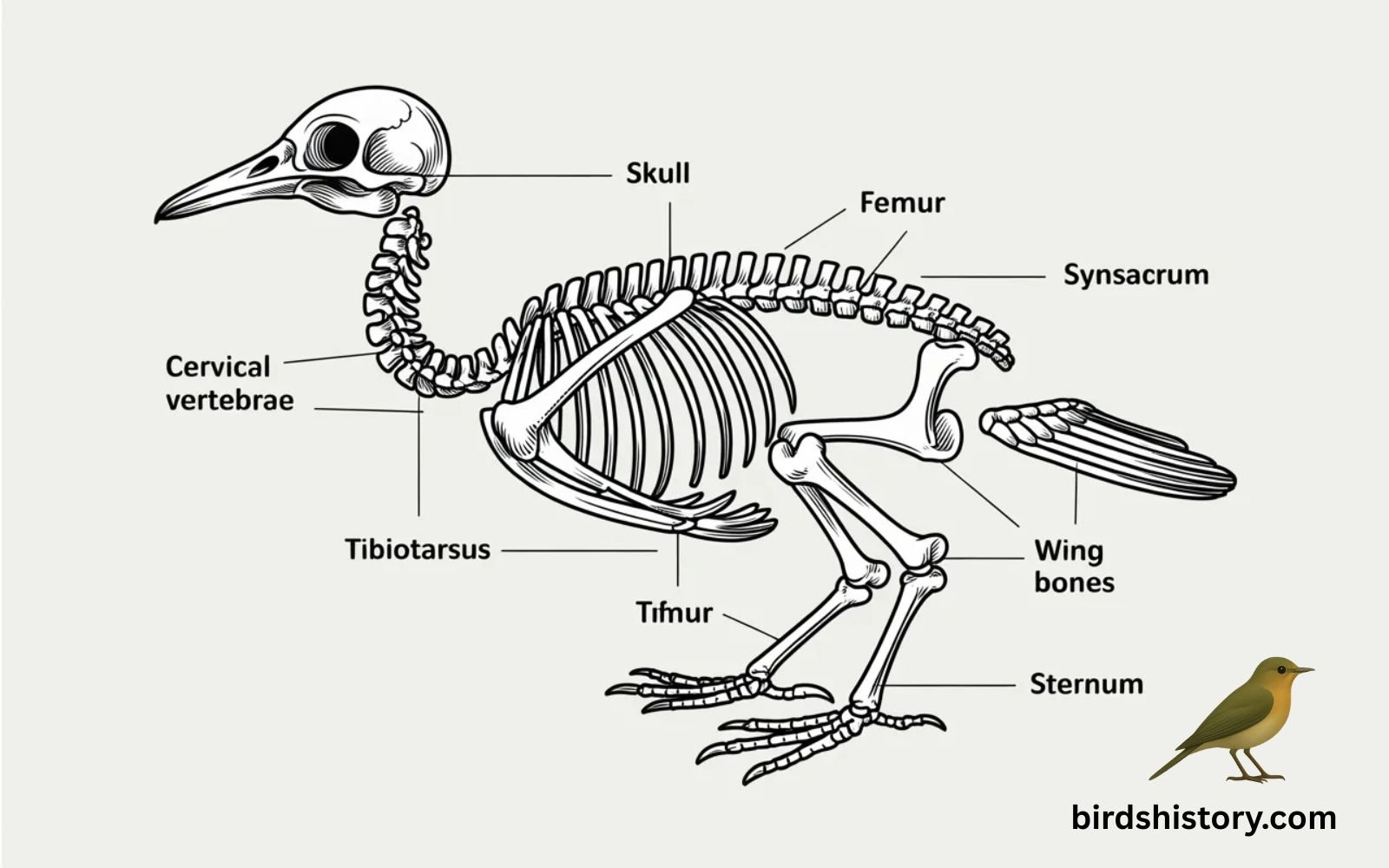
Consider how bird locomotion adaptation differs among species in North America. Hawks demonstrate powerful wing strokes for speed. Herons rely on extended legs for shallow waters. The diversity stems from structural refinements in bones such as the synsacrum bone, which prompts the common question, what is synsacrum in birds. This fused vertebral structure anchors the hips and tail, enhancing stability. Through subtle changes in bone shape and proportion, birds achieve extraordinary mechanical precision.
Bone Density and Lightweight Adaptations
Lightness without weakness defines the bird skeleton. Scientists often highlight the marvel of lightweight bird bones, which possess internal struts resembling architectural trusses. These struts distribute force evenly, preserving strength. The secret lies not in thinness alone but in intelligent design. That impressive strength-to-weight ratio allows even large birds like bald eagles to remain airborne.
Bone density varies by lifestyle. Diving birds have denser bones to reduce buoyancy. In contrast, soaring birds exhibit more air-filled spaces. This adaptation connects directly to the air sac system in birds, a key component of the avian respiratory system. High respiratory efficiency supports a high metabolic rate, essential for powered flight adaptation. Together, these traits reveal how bird skeleton helps in flight while conserving energy.
Why Are Bird Bones Hollow?
Ask any curious student why are bird bones hollow and you’ll uncover a fascinating story of efficiency. The hollow bones in birds are not empty cavities but reinforced chambers. These chambers integrate with pneumatic bones, which link to air sacs. This design reduces weight while preserving durability. It’s a perfect solution for sustained lift.
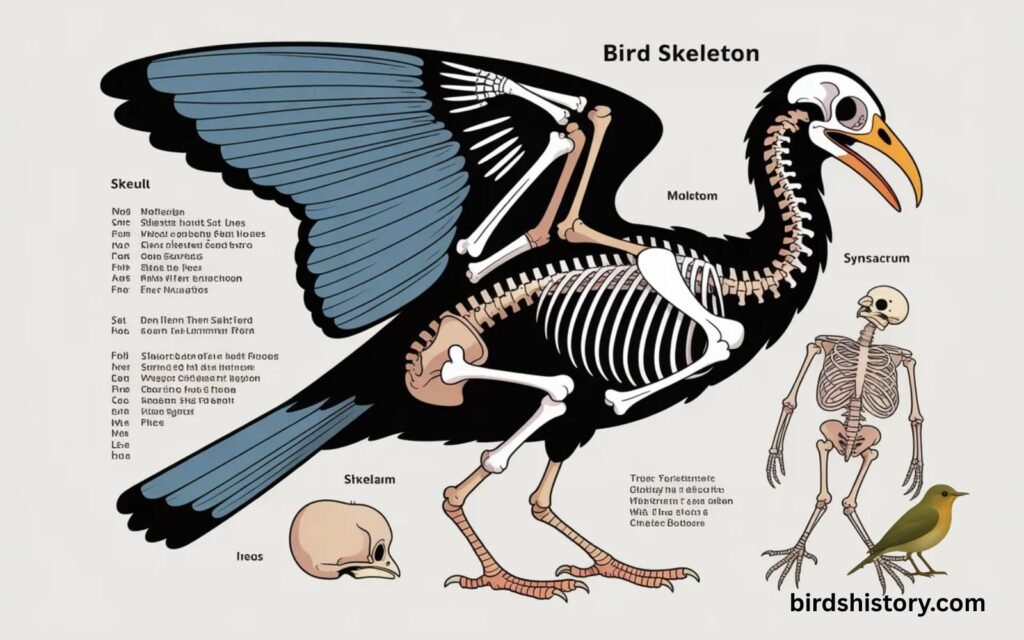
The hollow structure also enhances oxygen delivery. Air flows through bones and lungs in a continuous cycle known as the bellows mechanism breathing system. This oxygen exchange system ensures birds receive fresh air during both inhalation and exhalation. The answer to how birds breathe during flight lies here. The synergy between skeleton and lungs transforms the entire body into a living air channel.
Pneumatic Bones and the Respiratory System
Pneumatic bones play a starring role in avian performance. These air-filled structures connect directly to the avian respiratory system, forming part of the air sac system in birds. Unlike human lungs, bird lungs remain relatively fixed. Air sacs expand and contract instead. This creates continuous airflow, which dramatically increases respiratory efficiency.
Such efficiency supports avian thermoregulation and sustained activity. As homeothermic birds, they regulate body heat through a specialized heat exchange system. The four chambered heart in birds pumps oxygen-rich blood rapidly through the bird circulatory system, meeting the demands of a high metabolic rate. When you see a falcon dive at astonishing speed, remember that its pneumatic skeleton helps fuel that performance.
Skull Structure and Feeding Strategies
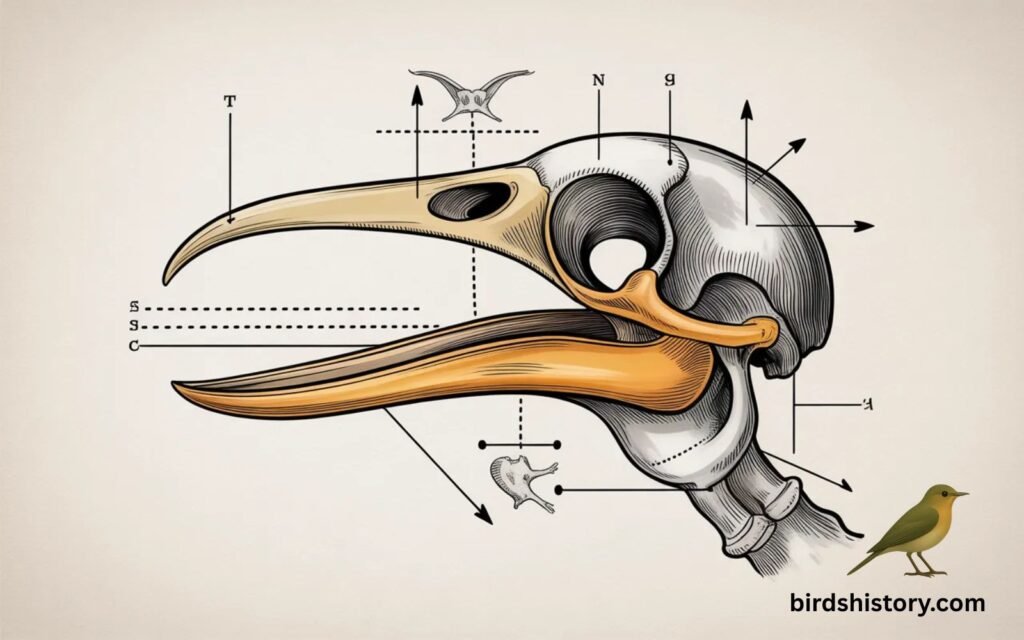
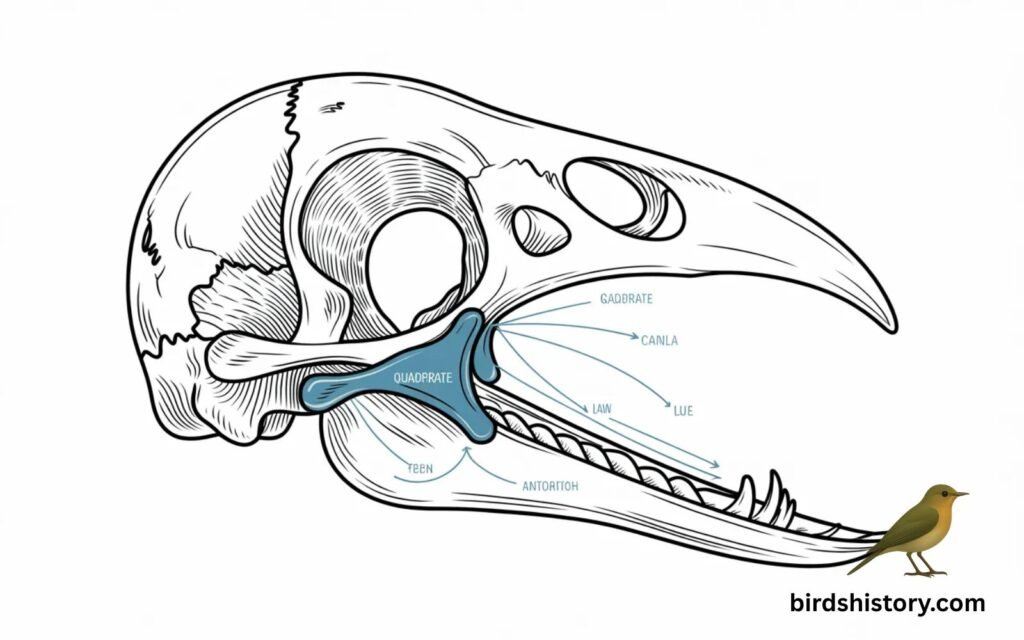
The bird skull structure reveals another layer of innovation. Compared to reptiles, the difference between bird and reptile skull lies in mobility and weight reduction. Birds possess a flexible joint known as quadrate bone articulation, which permits upper mandible movement. This mobility increases feeding versatility.
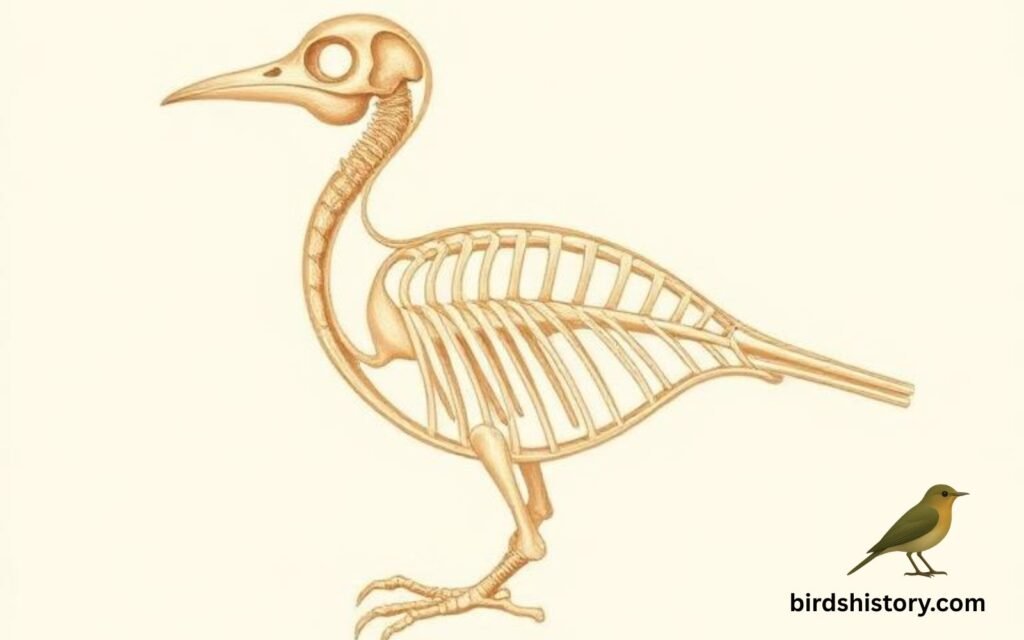
Different diets shape skull evolution. Seed eaters develop strong beaks for cracking shells. Wading birds exhibit elongated bills for probing mud, reflecting distinct wading bird anatomy. Predatory species showcase sharp beaks and enhanced binocular vision in birds, supporting predatory bird adaptations. Owls refine this further with sound localization in owls, a crucial nocturnal hunting adaptation. These variations illustrate adaptive diversification across bird orders and families.
Bird Skeletons, Flight, and Walking Adaptations
Flight reshaped the entire skeleton. The prominent bird sternum and keel answers the common question why birds have a keel bone. This large ridge anchors the powerful pectoralis muscle and supracoracoideus muscle. Together, they explain how flight muscles work in birds. Downstroke and upstroke coordination enables true powered flight adaptation.
Wing bones reveal further specialization. The carpometacarpus and tarsometatarsus result from digit reduction in birds and skeletal fusion. These modifications strengthen wings while reducing weight. Consider the table below for clarity.
| Bone Structure | Primary Function | Flight Relevance |
|---|---|---|
| Carpometacarpus | Supports primary feathers | Wing bone modification and structural strength |
| Furcula (wishbone) | Acts as a spring brace between shoulders | Stores and releases energy during wing beats |
| Coracoid bone | Stabilizes the shoulder joint | Essential for flight muscle attachment |
| Scapula in birds | Anchors wing muscles along the back | Supports skeletal biomechanics in flight |
Walking adaptations vary widely. The hallux adaptation enables grasping branches, which raises the question how perching mechanism works. Through tendon locking in the toes, birds maintain grip without muscular effort. This perching mechanism in birds reflects exquisite engineering within the avian pelvic girdle.
Muscles, Organs, and Skeletal Support
Behind every graceful flight stands an intricate partnership between bones and organs. The skeleton supports the crop and gizzard, which answer how bird digestive system supports flight. Food moves quickly through a lightweight digestive tract. Waste exits via the cloaca in birds, while uric acid excretion reduces water loss. The avian kidney structure conserves fluid efficiently.
Immune tissues like the bursa of Fabricius also reside within this compact frame. Efficient circulation and the four chambered heart in birds maintain oxygen supply. As homeothermic birds, they rely on precise avian thermoregulation to sustain energy. The integration of bones, muscles, and organs creates a living machine fine-tuned for survival.
Distinguishing Taxonomic Features in Bird Skeletons
The bird skeleton plays a critical role in the bird classification system used by scientists across the United States. Through careful study of bone shape, fusion patterns, and limb proportions, experts identify relationships among species. This approach forms the backbone of avian taxonomy and modern taxonomic classification. Subtle variations in the synsacrum bone, pygostyle function, and skull design help separate bird orders and families.
Evolution of the Avian Skeleton
Understanding how birds evolved from dinosaurs begins with examining the avian skeleton structure in deep time. Fossils demonstrate clear links between theropod dinosaurs and birds. Shared features include hollow limb bones, three-toed feet, and similar shoulder joints. These similarities go beyond coincidence and represent convergent evolution in birds only in limited traits, while most evidence reflects direct ancestry.
The transformation involved progressive skeletal fusion, digit reduction in birds, and wing bone modification. Early theropods already possessed lightweight limbs suited for speed. Over millions of years, these structures shifted toward powered flight adaptation. Paleontological evidence reveals gradual refinement rather than sudden change. Although fossil record gaps exist, enough transitional forms survive to illustrate a powerful evolutionary narrative.
The Origin of Feathers
Feather evolution did not begin with flight. Many dinosaurs with feathers likely used them for insulation or display. The origin of feathers in birds traces back to filament-like structures found in small theropods. These simple filaments gradually evolved into complex vaned feathers with defined feather attachment points on the skeleton.
As feathers became more aerodynamic, they supported gliding vs powered flight experimentation. Some scientists support the arboreal ancestor hypothesis, proposing that tree-dwelling dinosaurs glided before flapping flight emerged. Others argue for the terrestrial flight theory, suggesting ground-running predators developed wing-assisted leaps. Regardless of pathway, skeletal biomechanics and feather design evolved together in remarkable coordination.
The Origin of Flight
The origin of avian flight stands as one of biology’s most captivating transformations. Early forms likely combined cursorial adaptation with climbing ability. Gradual enlargement of the sternum and development of the bird sternum and keel enabled stronger flight muscle attachment. This anatomical shift answers how bird wings are structured and why birds have a keel bone.
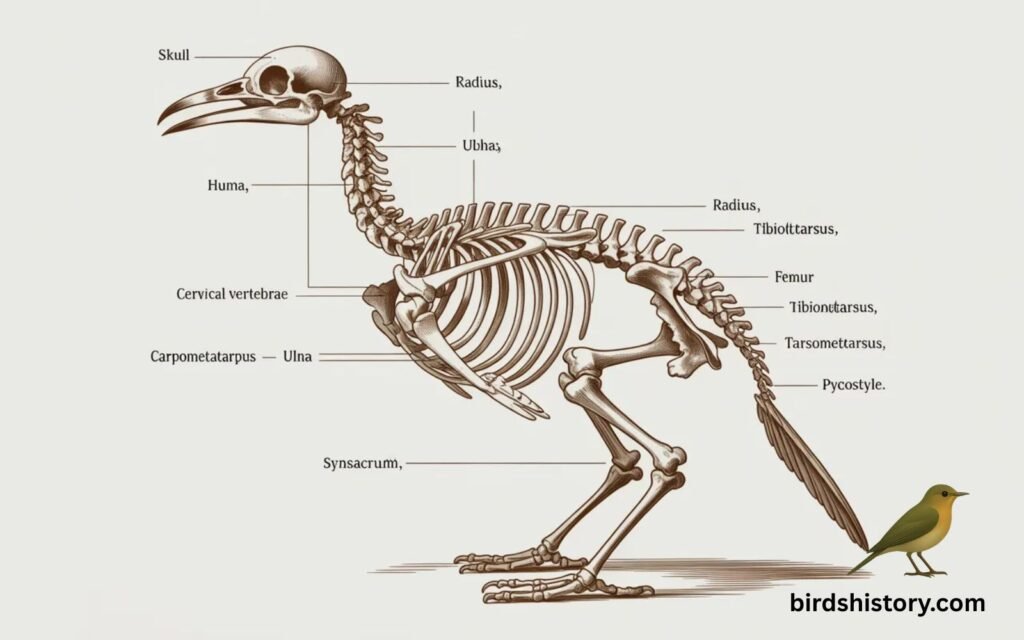
The pectoralis muscle powered the downstroke while the supracoracoideus muscle lifted the wing during recovery. Together, they created efficient wing cycles. Changes in center of gravity in birds improved balance during airborne maneuvers. Over time, the avian body plan became fully specialized for sustained flapping, marking a defining milestone in vertebrate evolution.
Fossil Birds and Paleontological Evidence
Few fossils capture public imagination like the Archaeopteryx fossil. Discovered in Germany, this specimen shows both reptilian traits and unmistakable feathers. Its teeth, long tail, and clawed wings illustrate a transitional stage. Cretaceous bird fossils from North America further document diversification during the age of dinosaurs.
These fossils supply critical paleontological evidence supporting evolutionary continuity. Still, fossil record gaps remain because delicate bird bones rarely preserve well. Despite this limitation, discoveries consistently align with DNA phylogenetics and skeletal comparisons. Each new fossil narrows uncertainty and strengthens understanding of how birds evolved from dinosaurs.
A simplified timeline highlights this progression.
| Time Period | Key Development | Evolutionary Significance |
|---|---|---|
| Late Jurassic | Archaeopteryx fossil appears | Early transitional feathered form |
| Early Cretaceous | Diverse Cretaceous bird fossils | Expansion of flight styles and skeletal variation |
| Late Cretaceous | Advanced sternum and pygostyle function | Improved aerial control and tail stability |
| Cenozoic Era | Modern bird diversification | Global adaptive diversification of bird groups |
Modern Birds: Skeletal Diversity Today
Modern bird diversification showcases extraordinary structural variety. From hummingbirds to ostriches, the avian skeleton structure adapts to ecological demands. Ratite evolution demonstrates flightless bird evolution in species like ostriches and emus. Their reduced keel and dense leg bones support cursorial adaptation rather than flight.
Marine diving birds exhibit compact bodies suited for plunge diving adaptation. Filter feeding birds such as flamingos display elongated necks and specialized beaks. Seed eating adaptations strengthen skulls for crushing grains. Arboreal lifestyle species refine perching mechanism in birds, while raptors perfect predatory bird adaptations. This evolutionary radiation illustrates how a single ancestral blueprint diversified into thousands of forms.
FAQs About Bird Skeleton
What is a skeleton of a bird called?
The skeleton of a bird is called an avian skeleton. It is lightweight yet strong, designed to support flight, protect organs, and allow efficient movement.
How many stomachs do birds have?
Birds have two main stomach parts: the proventriculus, which secretes digestive enzymes, and the gizzard, which grinds food. Some birds also have a crop for temporary storage.
Do birds have a bony skeleton?
Yes, birds have a fully bony skeleton, but many bones are hollow bones in birds, which reduce weight and aid in flight without sacrificing strength.
Why can’t birds have milk?
Birds cannot produce milk because they lack mammary glands. Instead, some species feed their young with regurgitated food or nutrient-rich crop milk, like pigeons and doves.
Can a bird feel pain?
Yes, birds have a nervous system similar to mammals and can feel pain, respond to injury, and show behavioral signs of distress.
How bird skeleton helps in flight
The avian skeleton structure is lightweight with skeletal fusion like the synsacrum bone and a keel on the sternum, providing flight muscle attachment for the pectoralis and supracoracoideus muscles, giving strength and balance during powered flight adaptation.
What is synsacrum in birds?
The synsacrum bone is a fused series of vertebrae in birds that connects the spine to the pelvis. It provides a rigid body framework, supports the center of gravity in birds, and stabilizes flight and walking.
Difference between bird and reptile skull
Bird skulls are lightweight, with quadrate bone articulation allowing upper mandible movement, large eye sockets, and reduced jaw bones, unlike the heavier, rigid skulls of reptiles.
How birds regulate body temperature
Birds maintain homeothermic body temperature through avian thermoregulation, using feathers, air sacs, a high metabolic rate, heat exchange systems, and behaviors like panting or fluffing feathers.
Conclusion
The bird skeleton represents a triumph of evolutionary engineering. From pneumatic bones to feather attachment points, every component reflects refinement shaped by millions of years. The avian skeleton structure balances durability and lightness through skeletal fusion and hollow chambers. It supports a high metabolic rate, precise skeletal biomechanics, and unmatched aerial skill.
Through paleontological evidence, DNA phylogenetics, and modern anatomical research, scientists continue uncovering details about how birds evolved from dinosaurs. Despite fossil record gaps, the story grows clearer each year. Whether examining bird skull structure, synsacrum bone stability, or powered flight adaptation, one truth remains consistent. The bird skeleton is not merely a framework of bones. It is the foundation of one of nature’s most successful and inspiring evolutionary achievements.